Näytetään tekstit, joissa on tunniste War. Näytä kaikki tekstit

tiistai 22. elokuuta 2023

Those “ordinary Russians” living in Finland: joining to Armed Forces of Russia


This text is based on my Finnish-language blog “Those ‘ordinary Russians’ fighting in the Armed Forces of Russia” (Fin. Ne ”tavalliset venäläiset” sotimassa Venäjän riveissä), which I published on July 8, 2023. For readers’ information, I have added more individual pictures to the blog. You should also note that some of the Russians living in Finland I mentioned in the blog have lived in our country for years or even decades. So, their enlistment as mercenaries or their support of Russian warfare cannot therefore be explained by the fact that they had only lived in Finland for a short time. Due to the Finnish Criminal Code, I have covered the faces of some of the pictures. Persons whose faces are covered live permanently in Finland.


Those “ordinary Russians” living in Finland: joining to Armed Forces of Russia

Over the years, I have made observations and written them down in the form of blogs about Finns fighting in Russia’s proxy forces or Russian subordinate forces in Eastern Ukraine; equally, I have observed the participation of Finns and Russians living in Finland in anti-Ukraine campaigning and information warfare in Finland and other countries. Part of this kind of campaigning can be considered a hybrid influence aimed at Finland – in practice a hybrid war, because for Russia it’s all about warfare, not hybrid influence. We Finns just scorn the name hybrid war, perhaps because in our mind’s warfare has a more concrete purpose meaning “blood and guts.”

In this blog, my attention is focused especially on Russians living in Finland who enlist in the Russian forces in Ukraine or support Russia’s military operations in Ukraine, some have been doing this since 2014, when the war in Donbas began.

Photo collage of Finns and Russians living in Finland working for Russia.


On June 27, 2023, Helsingin Sanomat published a background article “On Russia’s side” (Venäjän puolella), in which the journalists examined the hidden network of foreign fighters who fought in the Armed Forces of Russia in Eastern Ukraine. Marie-Agnes Strack-Zimmermann, chairwoman of the German Parliament’s defense committee, said the following about the network in question:

Such people with real war experience - who possibly killed others without remorse - are dangerous to our society.” (1)

With the article, I decided to write a blog about my own observations about Russians living in Finland (or people who speak Russian and living in Finland) who have participated in the war with the Russian forces in Eastern Ukraine in one way or another. This group also includes Russians who lived in Finland and have returned to Russia after February 24, 2022, to participate in Russia’s brutal war against Ukraine.

However, at the beginning of my writing, a brief review of the involvement of Russians or pro-Russians living in Finland in activities supporting Russia and influence in Finland, after Russia’s occupation of the Crimean Peninsula (February-March 2014) and the war started in Eastern Ukraine in April 2014. Their activity has been so long-term, and it has involved so much various levels of activism that this review only includes some key points and noteworthy events (with sources and background text links).

One of the most significant branches of this activity, influence and activism that includes targeted harassment is the result of an article written by Yleisradio journalist Jessikka Aro about the Russian troll factory. (2) Mainly Finns participated in the widespread harassment (it was practically psychological violence), but in which e.g., Johan Bäckman use of his contacts in Russia building it up. He also used various Russian media for a smear campaign against journalist Aro. I recommend everyone to read the non-fiction book ‘Putinin trollit – Tositarinoita Venäjän infosodan rintamilta’ of Russia’s information war written by Jessikka Aro and translated into several languages.

For years, attention in Finland was paid only to information influencing and propagandistic communication carried out by Russia and the Russians living in our country. Involvement in other activism and possible hybrid warfare operations emerged more broadly in connection with investigations related to special real estate deals and construction projects. But even then, Finland was careful not to talk about Russia’s possible hybrid operations or preparations for some Gray area activity. In her book ‘Putinin pihapiirissä,’ Tuula Malin brings up vague business acquaintances along with numerous shady real estate transactions. Despite this, e.g., in the case of Airisto’s pearl (Airiston Helmi), the official communications in Finland spoke of financial crime, while in Latvia, on the other hand, in the case of the same oligarch – Pavel Melnikov – there was essentially a more direct reference to possible security threats that the person’s holdings in the country create. (3)

The support of the Russian administration’s politics and imperialist wars of conquest was best seen in Finland precisely in the field of information influence and propaganda war. After Russia occupied the Crimean Peninsula from Ukraine in February-March 2014, activities supporting Russia began to be organized more widely in Finland, by Finns who support the Russian regime and Russians living in Finland. In the beginning, their public activities were oriented towards events that received media coverage. At that time, the attitude of the Finnish media to the events was childishly naive, some journalists even seemed to believe the propaganda stories about “separatism” in Donbas and “persecuting the Russians.” The later events were clearly more propagandistic, which the Finnish media could take a more critical view of.

In addition to the organization of various events and occasions, association activities played a more visible role, in which Finns and persons of Russian background living in Finland – or persons who declared themselves Russian in the armed forces – actively participated. Among the prominent associations, the DNR-edustamiskeskus ry ( appeared as the official representative of the “Donetsk People’s Republic” in Finland. Naturally, it didn’t really have that role, even though the people behind the operation claimed so. The Ministry of Foreign Affairs of Finland had to correct the disinformation spread by the association. (4)

DNR-edustamiskeskus ry and Donetskin kansantasavallan ystävät Suomessa organized a few Christmas parties, which were attended not only by Finns but also by Russians living in Finland. At least once among the guests was also Natalia Nikonorova from the occupied territories of eastern Ukraine. At that time, Nikonorova appeared at the event in the role of “Foreign Minister,” which role she had in the puppet administration appointed by the Kremlin. In the first years of its activity, DNR-edustamiskeskus ry was highly active as a spreader of propaganda and disinformation. Propaganda material from Russia and the occupied territories of eastern Ukraine was also brought to Finland through it. In the last years of visible activism, among the collaborators of DNR-edustamiskeskus ry was also RUFI – suomalais-venäläinen yhdistys ry, which supported the imperialist policy of the Russian government, and was headed by Daria Skippari-Smirnov at the time.

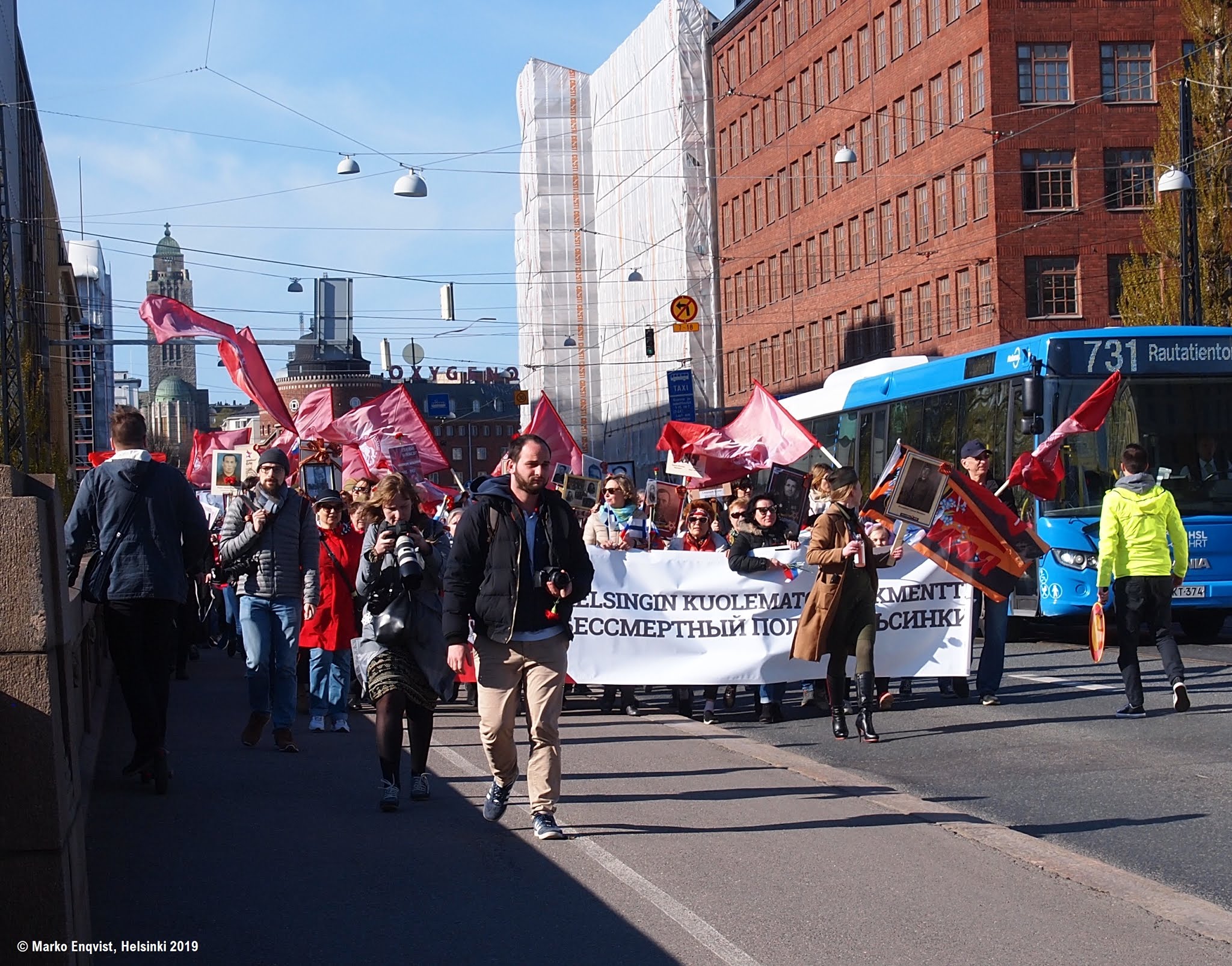
Under Skippari-Smirnov’s leadership, the first Immortal Regiment March was organized in Finland in May 2017. (5) After this, Skippari-Smirnov has organized two more Immortal Regiment marches in the name of RUFI and, after the corona pandemic, in May 2022, a car march that ended in Helsinki. During the active years, a lot of disinformation and pro-Russia propaganda was shared on the association’s social media platforms and website. Under the leadership of Skippari-Smirnov, the association also played a prominent role in the journey to the Russian-occupied Crimean Peninsula in the spring of 2018.

Johan Bäckman’s recruitment of fighters to the Russian proxy forces in Eastern Ukraine (especially in 2015 and 2016), and the delivery of various materials to the war zone in Eastern Ukraine through Russia, played its part in the activities in Finland. People of Russian background living in Finland and the companies they own also have part of this activity. (6)

I have previously written several blogs on the subject, the most recent one in December 2021. In recent years, the Finnish media have also more actively examined such activities and direct participation in hostilities in the Armed Forces of Russia – this was also the case in the extensive article published in Helsingin Sanomat and the articles published in Yleisradio in autumn and winter 2021. (7 and 8) In my blogs, I have focused mainly on the recruitment of fighters of Finnish background. But this time I am focusing on the participation of people of Russian background living in Finland in the war in Eastern Ukraine and specifically in the Armed Forces of Russia. Helsingin Sanomat’s article on ‘Venäjän puolella’ offers an excellent basis from which to proceed.


Onko tšuhna nenästä vedettävä – Are we Finns idiots, in Russian tšuhna is a derogatory term used for Finns

After the introduction, we can then move on to the matter itself, i.e., to examine the participation of persons of Russian background living in Finland in the Russian Army in the war in Ukraine. In my writing, however, I ignore the examination of the mercenary army connected to Gennadi Timchenko, which has recently caused a lot of buzz in Finland as well. (9) The reason for sidelining the topic is simple. A closer look at the mercenary army, or Redut, connected to Timchenko would make this article far too long. But the fact that before this year no attention was paid in Finland to Timchenko’s ownership of Redut, speaks volumes about the secrecy that has prevailed around Gennadi Timchenko on a wider scale. Note Timchenko also has Finnish citizenship!

In Finland, the idea that Vladimir Putin’s political opponents in Russia would automatically oppose the war (or the so-called special operation) has been pampered for a very long time. However, such a belief is completely wrong! In May 2023, Sergei Porohovoi, an activist of The Other Russia of E. V. Limonov party who lived in Finland for more than a decade, returned to Russia of his own free will, announcing that he was ready to join the forces of the Interbrigady movement operating in the Russian-occupied Donbas region as a volunteer. Interbrigady movement have been fighting against Ukraine as part of Russian forces in eastern Ukraine since 2014. The forces in question are suspected of having committed war crimes in the war zone of eastern Ukraine. According to an activist source known to Porohovoi, Porohovoi decided to return to Russia, after life in Finland became mentally impossible due to Ukraine frenzy and Russophobia. (10)

In The Other Russia of E. V. Limonov party, founded by Eduard Limonov, extreme leftism and fascism were combined into a national Bolshevik ideology. National Bolshevism is a political movement that combines nationalism and Bolshevism. The ideological anti-Americanism is also significant for the movement. The original goal of The Other Russia of E. V. Limonov party has been, among other things, referendums in Russian-majority areas in Russia’s border neighbours on joining Russia. Today, Russia has become radicalized to such an extent that National Bolshevism is not much different from the “ideology” in power in Russia, where Putinism and fascism have combined to form Russism. Now we must ask ourselves whether we have been a little too naive when it comes to Putin’s political opponents and our attitude towards them.

Porohovoi was one of Putin’s ideological opponents, but he has returned to Russia and is ready to participate in Russia’s brutal war against Ukraine, but how many ‘porohovoi’s’ have we raised on our knees?

In Helsingin Sanomat’s article on ”Venäjän puolella,” comments are asked from a Russian living in Finland, Pavel i.e., Pavel N, about his participation in the war with Russia against Ukraine. Pavel, like many others, acknowledges that he was on a humanitarian mission and did not participate in the fighting. The same was claimed by British citizen Benjamin Stimson, who years ago in Great Britain was sentenced to several years in prison for participating in the war in Russian proxy forces against the Ukrainian government. (11) Stimson, like Pavel, has appeared in pictures with an assault rifle in a war zone, which was enough for Stimson to be sentenced.

In the Helsingin Sanomat article, a picture of Pavel holding a weapon that looks like an assault rifle has been picked up. According to Pavel, it is a weapon used in airsoft. A couple of active reservists gave me a reasoned dissenting opinion, so it may or may not be an airsoft gun. On the social media of Pavel’s friends, you can find more interesting pictures in which Pavel N. also appears – in some of the pictures, armed.

Some of the pictures in which Pavel N. and his friends appear were probably taken in connection with airsoft, but the activity and training seen in some of the pictures reminds me of something other than airsoft. Based on the dilapidated buildings visible in the photos, they were taken somewhere other than Finland. Based on the names of the people in the photos, I would conclude that they were taken either around St. Petersburg in Russia or possibly in the eastern parts of Estonia.*

Pavel N., partial image of the original image.


“Airsoft” training “out there somewhere.”


A picture of the area where Russians living in Finland also go to practice “airsoft.” Location likely near St. Petersburg, Russia. 


The pictures inevitably remind me of the pictures from years ago that were published from the Partizan camps organized by the Russian Imperial Movement or from the camps of the Evraziyskiy Soyuz molodezhi i.e. ESM, which were attended by teens and a young adult from the eastern parts of Ukraine years before the war started by Russia in 2014. (12 and 13) ESM’s ideological “youth camps” were events where Eurasianism (or neo-Eurasianism) was spread to Russia's neighbouring countries through the networks created. Along with Evraziyskiy Soyuz molodezhi, similar activities were also carried out through Mezhdunarodnoe Evraziyskoe Dvizhenie, both based on the ideas of Aleksandr Dugin.

When browsing the social media network of Pavel N and his friends, there are also other persons of Russian background who declare their place of residence in Finland, who have delivered material aid at least since 2014 to the war zone of eastern Ukraine, more precisely, to the areas occupied by Russia. This means that, with a very high probability, they have driven to the area via Russia (at the very least guilty of the Ukrainian state border crime, at the most a lot more). “Cure Morozov,” who claims to be based in Turku, has published a picture on social media which are taken in frontline conditions, along with aid pictures.

Despite the international verdict and Russia's extensive war crimes, February 24, 2022, has not formed a limit to Russian support for Russia by Russians living in Finland or pro-Russian Finns. As can be seen from the Helsingin Sanomat article, Pavel N has been sharing PMC Wagner’s recruitment ads on social media since February 24, 2022, but has gone even further. I know of at least one case where a man of Russian background who moved to Finland a few years ago (before the corona pandemic) – Yevgeni K – has returned to Russia to participate in Russia’s war of aggression against Ukraine.

Yevgeni K’s background is so interesting that you would think it would also arouse our authorities. According to reliable information, before moving to Finland, he worked in Russia in special forces under the Ministry of the Interior in St. Petersburg and/or the Leningrad region, rising to the rank of officer. He moved to Finland after his service contract ended. Those who know him suspect (justifiably) that Yevgeni K hid his true work history and background when he arrived in Finland.

It can at least be stated that, so far, the actions of our authorities regarding the investigation of the actions of those who fought in the Russian forces have been quite lax. Coincidentally, just today Ilta-Sanomat published an extensive article that talked about the long-running investigation by the Häme police and The National Bureau of Investigation, the target of which is a Russian man living in Finland, who, according to Ukrainian sources, has fought in the PMC Wagner owned by Yevgeni Prigozhin. (14) It is noteworthy that the man was treated as a possible witness in the chain of events related to the shot down of Malaysia Airlines flight MH17.

Image from the Ilta-Sanomat article, July 8, 2023.


It is interesting that Suojelupoliisi – Finnish Security and Intelligence Service (Supo) has not publicly paid attention to the Finnish foreign fighters who fought in the forces of Russia in Eastern Ukraine. Instead, in his national terrorism threat assessment published this spring, Supo warns about individual extremists who have traveled to fight on the other side, i.e., with the Ukrainian forces. A journalist from Helsingin Sanomat asked Supo what they think about those Finns who have participated in the war in Donbas on the Russian side – “Does Supo consider them a security threat? What kind of security risk can they cause when they return to Finland?” (15) Supo’s answer was that they have nothing to comment on. Instead, according to researcher Kacper Rekawek, who specializes in foreign fighters who fought in Ukraine, foreign fighters who have returned to their home countries and fought in the ranks of Russia are especially now a security threat – “In practice, they are Russian agents.” (16)

The same evasion on the part of our authorities was already noticeable years ago, when I made a request for an investigation into the activities of Johan Bäckman and Janus Putkonen. I covered the case in more detail in my blog on December 4, 2021. For those who can’t read the blog, I state that the National Prosecution Authority decided that there is no reason for a preliminary investigation. I was hoping that tšuhna has caught on since then, but I’m afraid I’m wrong. The Russians are still laughing at the naive tšuhna!


Marko


Sources:

1. https://www.hs.fi/ulkomaat/art-2000009511795.html  (Behind paywall). 

2. https://kioski.yle.fi/omat/kioski-pietarin-trollitehtaalla 

3. https://ir.lv/2018/11/30/russias-hand/ 

4. https://vartiopaikalla.blogspot.com/2017/12/kaiken-takana-on-backman.html 

5. https://www.verkkouutiset.fi/a/venalaisten-yhdistys-tuomassa-voitonpaivan-kuolemattoman-rykmentin-marssia-suomeen-64692/#194c9420 

6. https://vartiopaikalla.blogspot.com/2019/03/kalastelua-johan-backmanin-verkoilla.html 

7. https://yle.fi/a/3-12153718 

8. https://yle.fi/a/3-12210484 

9. https://www.iltalehti.fi/ulkomaat/a/ccc85850-6026-4ef4-9b2a-2e673a603fef 

10. https://www.is.fi/ulkomaat/art-2000009578041.html 

11. https://www.independent.co.uk/news/uk/british-man-prorussian-forces-ukraine-jailed-terrorism-benjamin-stimson-a7842521.html 

12. https://m.vk.com/partizan_kurs 

13. http://anton-shekhovtsov.blogspot.com/2016/01/how-alexander-dugins-neo-eurasianists.html 

14. https://www.is.fi/ulkomaat/art-2000009701271.html 

15. https://www.hs.fi/ulkomaat/art-2000009511795.html 

16. https://www.hs.fi/ulkomaat/art-2000009511795.html 


*: When analyzing the networks of people of Russian background living in Finland, it is also revealed that at least some of them have connections with the Russian imperialist Russian Imperial Movement, or RIM, headquartered in St. Petersburg. As well as to members of RIM who have fought in the Russian forces in eastern Ukraine.

RIM organizes military training for various groups in St. Petersburg and the Leningrad region. The courses organized by it have also been attended by members of the Nordic Resistance Movement. I would not consider it impossible that Russians living in Finland would go to RIM’s camps to train. Yes, maybe at these camps they practice that “airsoft”!

Note – In the near future, I will translate the continuation of this blog into English, where I will be more specific about the connections of Russians living in Finland to Russian extremists, such as the Russian Imperial Movement.


#StandWithUkraine 


keskiviikko 18. toukokuuta 2022

RuFi ry – part of Russian propaganda and influence in Finland


Finland is called a promised country for associations because their establishment threshold is low, and associations have a long history in our country. Thus, the associations also operate as a channel of influence and recruitment channel for state organizations, which is also known in Russia.

Russia seeks to influence Finns in numerous ways, one such route being registered associations and groups founded by civic activists. I will briefly review the RuFi ry, i.e., Suomalais-venäläinen RuFi ry (the Finnish-Russian RuFi ry) and its activities in recent years. (Note: ry = rekisteröity yhdistys, registered association).

RuFi ry rose to the headlines for the first time in the spring of 2017 when organizing the first “Immortal Regiment-March” in Finland. (1) More than a hundred Finns and Russians living in Finland took part in the march. The photographs also showed the presence of individual activists from the Suomi Ensin movement, which belongs to the right wing. Marco de Wit, the founder and those time leader of the Suomi Ensin movement, visited the occupied Eastern Ukraine in July 2016 with a Finnish propaganda group.

Prior to this spring’s “car parade” RuFi organized a total of three immortal regiment marches, in 2017 and 2018, and in 2019. During the coronavirus pandemic, RuFi did not organize an immortal regiment march, anyway, between the beginning of 2020 and the end of 2021, the organization lived a quiet life until in December 2021, the group became again active on social media. After Russia attacked Ukraine on several fronts on February 24, 2022, RuFi’s activity on social media increased. So, the car parade held on May 8 was a natural continuation of this activation. According to a Facebook article published by the organizers of the “car parade,” the procession supports Russia “in its difficult struggle against Nazism and fascism and Russophobia”. (2) In practice, the car parade was a demonstration of support for Russian imperialism and the Russia’s invasion of Ukraine.

There is a very wide right of demonstration in Finland, due to which it was not possible for the authorities to ban the car parade in advance, because the organizer was an association that is not banned or whose activities have not been restricted in any way. Demonstration in Finland does not require a permit, it is enough for the organizer to report the protest to the police.

Photo from the Immortal Regiment march (car parade) of Helsinki from May 2022, photographer unknown.


RuFi’s previous actions

As I wrote, RuFi ry has organized the March of the Immortal Regiment three times, in 2017 and 2018 and 2019. More than a hundred Russians living in Finland and their supporters took part in the first march of the immortal regiment, and the third march on May 9, 2019, was attended by more than 150 Russians living in Finland as well as their supporters. Pirkko Turpeinen-Saari, a well-known SKDL (Suomen Kansan Demokraattinen Liitto, English Finnish People's Democratic League) politician and former Member of Parliament, also took part in the third march. Turpeinen-Saari has also become known as a contender for the massacre of Srebrenica by the Serbs and an inventor of various conspiracy theories. (3) In her view, Srebrenica is a United States propaganda operation. Daria Skippari-Smirnov, the then chairman of the association, was responsible for organizing the third march, as well as previous marches. According to Skippari-Smirnov, the chairman of RuFi ry is currently a man named Heorhi Mirashnichenka, who according to the register of associations is the vice-chairman. (4)

The Immortal Regiment march in may 2019, Skippari-Smirnov in a brown coat and garrison cap in her head.*


In addition to the marches of the immortal regiment, RuFi and its prominent actors, such as Daria Skippari-Smirnov and Marina Muhonen, have also participated in other events in support of Russia and its imperialist policies. Such as the opening ceremony of the “Representation” of the Donetsk “People’s Republic” established in Helsinki together with the members of Suomi-Novorossija-Seura (Eng. Finland-Novorossiya Society) from the end of 2017. Prior to that, there was the “Embassy of Novorossiya” in Finland, which was replaced by that embassy.

However, readers should be aware that this “representation”, like its predecessor, does not have the status of an official embassy. Finland has never recognized the “people's republics” of Donetsk or “people's republics” Luhansk, nor has it given official status to their “embassies”, even though the people behind the “embassies” claim so. So, the nature of the “embassy” of Novorossiya in Finland as well as the “representation” of the “People’s Republic” of Donetsk has been clearly propagandistic and disinformative. The out-of-date website continues to share disinformation and direct unfair allegations against our authorities. (5)


Declaration of the Friends of the Donetsk “People’s Republic”, Daria Skippari-Smirnov and Marina Muhonen from RuFi also as signatories.


Johan Bäckman and Daria Skippari-Smirnov (RuFi ry) in the Russian-occupied Crimean Peninsula, March 2018.


During the so-called presidential elections in Russia in March 2018, the Finnish delegation traveled to the Russian-occupied Crimean Peninsula. In addition to Johan Bäckman, the travel group also included Daria Skippari-Smirnov and a few other Finns. The trip can be described as propagandistic in content, marked by the fact that, at the same time, Russia was holding illegal presidential elections on the occupied Crimean Peninsula. Finns, Johan Bäckman participated in these so-called elections as an “election observer”, a few other members of the Finnish group visited “polling stations” at the time. (6) In addition to Daria Skippari-Smirnov, Chairman of the RuFi, at least Marjaliisa Siira, an active member of the Rauhanpuolustajat, reported on her visits to the “polling stations”. At the same time, Siira spread a lot of disinformation and propaganda.

In addition to the above, Eero Hult, who were candidates for the Finnish municipal elections, Svetlana Mustonen and Ludmila Odintsova took part in public appearances during the visit. The delegation’s most prominent proposals included the opening of a direct flight connection between Helsinki and Simferopol and the proposal to establish a Finnish-Russian business and cultural centre on the occupied Peninsula. These proposals, like the others, are mainly part of theatre and propaganda, so there is no need to give them more space in this context.

On 19 March 2019, Ukraine imposed sanctions on private individuals pursuant to a decision of the National Security and Defense Council of Ukraine, at which time sanctions were also imposed on Daria Skippari-Smirnov, chairman of the RuFi ry. One reason was her actions on the Russian-occupied Crimean Peninsula. At that time, in addition to Skippari-Smirnov, sanctions were imposed on Johan Bäckman, Janus Putkonen, Jarmo Ekman and Jon Hellevig (deceased 26 May 2020, Moscow), as well as Kai Paananen and Oleg Usachov, a Russian living in Finland. (7)

Prior to the coronavirus pandemic, RuFi’s representatives prominently participated in various events held in Finland, which were united by the dissemination of Russian disinformation and its attempts to influence abroad. A particularly prominent speaker on RuFi was chairman Daria Skippari-Smirnov, who, in addition to her interviews with the Russian media, gave a presentation at the Hybrid Wars and Finland discussion event in Helsinki in March 2019. The discussion was organized and moderated by Johan Bäckman. At the same time, the event was the launch of the book “Hybrid Wars” wrote by Russian professor and political scientist Igor Panarin. Since that work, Panarin has published at least one more book via Johan Bäckman Publications’. Given the current situation, we can say that Panarin does not have at least the gifts of a fortune teller.

At that discussion, Skippari-Smirnov's presentation was about the (human) rights of the Russians and the war on information – the topic is interesting in that the (human) rights of the Russians are being trampled on today, if anywhere, in Russia. This presentation, as well as the event, must be seen in its context, it was nothing more than the dissemination of disinformation combined with an attempt to destabilize our civil society, as is clear from the performers and topics. Many of the performers participate in various groups disseminating conspiracy theories, such as Jarmo Ekman, or in counter-media and social media projects that try to break social peace, such as Juha Korhonen, the topic of his presentation was “lies in the mainstream media and blackmailing the free media”. Korhonen sees traditional media as false, which tarnishes counter-media.

RuFi has strongly supported the Russian war in Ukraine even before the large-scale offensive that began on February 24, 2022. In addition to the previously signed declaration of friends of the Donetsk “People’s Republic”, this is reflected in the dissemination of propaganda and disinformation, as well as in participation in events that support the goals of the Russian regime. As an association, RuFi had time to be active on social media for years, as it also previously had a website (rufi.fi) whose domain has now been taken over by an outsider and which conveys its greetings to the Russians through the web pages. The Russian embassy has also taken note of the association’s activism in the past, although otherwise the embassy – in public – kept a certain distance from the association’s activities. The car parade in May this year was at least morally supported by the Russian embassy. (8)


Certificate of Merit for Daria Skippari-Smirnov, signed by Nikolai Zemtsov, Member of Parliament, Russia.


I consider it very probable that the activation of RuFi is due, at least in part, to the activities and messages conveyed by the Russian Foreign Ministry, which have also been passed on by the Russian Embassy in Helsinki. In the example (picture below), the Russian Embassy in Finland asks you to report conspiracies, discrimination and hatred against Russians to your tweet email address. The same message has been passed on by the Russian Foreign Ministry – their communication also speaks directly of “Russophobia”. A fashion term that the Russian administration deliberately and intentionally misuses to suppress objective and appropriate criticism of the regime. A term used to stigmatize critics of the Russian regime.


In addition to the visible influence, RuFi activists participate in the WhatsApp group of Russians in Finland, which was hotly debated before the May car ride. Screenshots of the group’s discussions show that the Russian-speaking group is spreading Kremlin hate propaganda against Ukrainians and inciting violence. A group of about 80 people was formed in mid-April and has been named the Autokulkue. (9) One of the most active members of the WhatsApp group is Daria Skippari-Smirnov, former chairman of RuFi.

The discussion in the group follows the same lines as Russian state propaganda. In the discussion of the WhatsApp group, Ukrainians are also being demonized and de-humanized. The group is even proposing to bring shovels (in the car ride) so that the Ukrainians can be buried. Even such writing causes nothing but laughter in the group. (10)

This post is largely based on a blog “RuFi ry – Venäjän pienimuotoista vaikuttamista Suomessa”, I wrote in Finnish earlier in May.


Marko 


Sources:

1. https://seura.fi/asiat/ajankohtaista/video-voitonpaiva-helsingissa-pursui-neuvostonostalgiaa-ja-venalaisia-kansanlauluja/ 

2. https://yle.fi/uutiset/3-12429485 

3. https://www.turpeinen-saari.net/blogi/2015/07/10/424 

4. https://www.hs.fi/kotimaa/art-2000008779634.html 

5. https://dnrhelsinki.com/ 

6. https://www.fakeobservers.org/biased-observation-database/details/baeckman-johan.html 

7. https://www.president.gov.ua/storage/j-files-storage/00/65/10/26ff8d8c25d2081f4e3666cba71bddf9_1553072270.pdf 

8. https://yle.fi/uutiset/3-12429485 

9. https://putinintrollit.fi/2022/05/05/suomenvenalaisten-whatsapp-ryhmassa-keskustellaan-aseiden-tuomisesta-venaja-mieliseen-kulkueeseen-ja-lietsotaan-vihaa-ukrainalaisia-vastaan/ 

10. https://putinintrollit.fi/2022/05/12/vierasblogi-mita-keskustelut-suomenvenalaisten-whatsapp-ryhmassa-kertovat-venajan-kulttuurista-ja-propagandasta/ 


*: Photo by Marko Enqvist

perjantai 6. elokuuta 2021

Itä-Ukrainan miehitetyt alueet: 1. armeijakunta


Heinäkuun viimeisenä päivänä julkaisemassani blogissa kävin läpi Venäjän merkittävimpiä tukikohtia sekä varikkoalueita Ukrainan rajalla sekä miehitetyssä Itä-Ukrainassa, tässä (kuin myös seuraavassa) blogissa siirrymme Ukrainalta miehitettyyn Donbasiin, miehitetyillä alueilla operoiviin Venäjän johtamiin ja varustamiin armeijakuntiin, 1. armeijakuntaan miehitetyn Donetskin alueella ja 2. armeijakuntaan. Tässä kirjoituksessa huomio kiinnittyy miehitetyn Donetskin alueella operoivaan 1. armeijakuntaan, mutta viittauksenomaisesti huomioin myös 2. armeijakunnan, jota vastaavasti tarkastelen syvällisemmin seuraavassa kirjoituksessani.

Venäjän Eteläiseen sotilaspiiriin kuuluvan 8. armeijan vastuualueella on Itä-Ukrainan miehitettyjen alueiden joukot, jotka – kuten edellä viittasin – muodostavat 1. armeijakunnan miehitetyn Donetskin alueelle ja 2. armeijakunnan miehitetyn Luhanskin alueelle. 8. armeijan esikunta sijaitsee Novotšerkasskissa. Itä-Ukrainan miehitetyillä alueilla operoivien 1. ja 2. armeijakuntien upseerit tulevat Venäjän asevoimista. Tavanomaisesti pesti kestää noin puolivuotta, komentoketjun alemmilla tasoilla pestit voivat olla pidempiäkin.

Itä-Ukrainan miehitetyillä alueilla operoivat 1. ja 2. armeijakunta ovat perustettu viimeisen viiden vuoden kuluessa. Niiden mallina toimii tavanomainen Venäjän maavoimien armeijakunta, mikä mahdollistaa niiden integroimisen Venäjän eteläisen sotilaspiirin rakenteeseen.

Joukkojen integroimista Venäjän eteläisen sotilaspiirin rakenteeseen tukee 1. ja 2. armeijakunnan kaksoisjohtorakenne kaikissa yksiköissä pataljoonatasosta ylöspäin.

Kummankin armeijakunnan joukko-osastot on varustettu lähes 100 prosenttisesti, samalla kuitenkin monet yksiköistä on vajaamiehitettyjä, mikä mahdollistaa sen, että yksiköt voidaan täydentää minä hetkenä tahansa Venäjän asevoimien miehistöllä, (jota on nähty sodan aiempina vuosina, esim. Debaltsevon taistelussa, jolloin Venäjä täydensi taisteluun osallistuvia joukko-osastoja asevoimista kootuista sopimussotilaista).

Pataljoona-tasosta ylöspäin suuntautuva viestintä on digitaalista ja salattua, perustuen Azartin- ja Arakhis-järjestelmiin.

Venäjän maavoimien 5. erillisen panssariprikaatin vaunukalustoa Vuhlehirs'kissa, Donbasissa, helmikuussa 2014.


Tuoreimpien komentovastuussa olevien upseereiden nimet eivät ole tiedossani. Talvella 2021 1. armeijakunnan komentajana toimi upseeri, josta käytettiin koodinimeä ”Primakov”, vastaavasti 2. armeijakunnan komentaja tunnettiin koodinimellä ”Knjazev” – on mahdollista, että kevään rotaation seurauksena kumpikin on jo vaihdettu uusiin komentaviin upseereihin. (1) Ensimmäistä armeijakuntaa aiemmin komentaneista upseereista voimme nostaa esille Narvassa syntyneen kenraalimajuri Aleksei ”Pilevin” Zavizonin, maahanlaskudivisioonaan komentaneen kenraalimajuri Valeri Solodtšukin, reserviin siirtyneen kenraaliluutnantti Andrei Gurulevin.

Venäjän Itä-Ukrainan joukkojen komentoketju.


Tällä hetkellä Venäjän, Itä-Ukrainaan sijoittaman, miehitysarmeijan vahvuus on yli 35100 sotilasta ja erilaista taistelijaa. Miehitetyn Donetskin alueella operoivan 1. armeijakunnan vahvuuden ollessa noin 20500 taistelijaa, vastaavasti miehitetyn Luhanskin alueella operoivan 2. armeijakunnan vahvuuden ollessa noin 14600 taistelijaa. Armeijakuntien käytössä olevan, Venäjän eteläisen sotilaspiirin alueelle sijoitetun, operatiivisen reservin koko on noin 12500 sotilasta/ taistelijaa.

Ukrainan ETYJ:lle talvella 2021 luovuttaman raportin mukaan 1. ja 2. armeijakunnalla on kalustoa seuraavasti. (2) Taulukkoa lukiessa on kuitenkin syytä muistaa se, että lukemiin ei sisälly esim. Kuzminkan ja Kadamovskyin alueille varastoitua kalustoa, kuten ei Kamensk-Šahtinskin alueelle sijoitettua kalustoa, eikä operatiivisen reservin kalustoa Novotšerkasskissa:


1. armeijakunta

2. armeijakunta

taistelupanssarivaunut

280

200

rynnäkkövaunut ja miehistönkuljetusajoneuvot

550

364

erilaiset tykistöaseet

410

310

raketinheittimet

120

90

erilaiset ilmatorjunta-aseet ja -järjestelmät

n. 400

n. 300


Lisäksi Itä-Ukrainan miehitetyillä alueilla operoivilla joukko-osastoilla on Ukrainan puolustusministeriön julkaisemien tietojen mukaan yli 450 erilaista panssarintorjuntaohjusten laukaisinta.

Syksyyn 2019 mennessä 1. armeijakunnan uudelleenorganisointi oli periaatteessa valmis. Armeijakunnan vastuulla olevan rintamalinjan pituus on 195 kilometriä. Seuraava lista käsittää 1. armeijakuntaan (yksikkötunnus: 00100) kuuluvat joukko-osastot:

- 1. mekanisoitu prikaati (yksikkötunnus: 08801), esikunta Kaliumisessa.

- 3. mekanisoitu prikaati (yksikkötunnus: 08803), esikunta Horlivkassa. Prikaati sisältää myös 1. aluepuolustuspataljoonan (yksikkötunnus: 08822).

- 5. mekanisoitu prikaati (yksikkötunnus: 08805), esikunta Donetskin alueella.

- 100. mekanisoitu prikaati (yksikkötunnus: 08826), esikunta Donetskissa. Prikaatiin kuuluu myös 3. aluepuolustuspataljoona (yksikkötunnus: 08815) ja 4. aluepuolustuspataljoona (yksikkötunnus: 08823).

- erillinen 9. mekanisoitu merijalkaväen rykmentti (yksikkötunnus: 08809), esikunta Novoazovskissa. Rykmenttiin kuuluu myös 6. aluepuolustuspataljoona.

- erillinen 11. mekanisoitu rykmentti Vostok (yksikkötunnus: 08818), esikunta Jasunuvatassa. Rykmenttiin kuuluu myös 2. aluepuolustuspataljoona (yksikkötunnus: 08814).

Edellisten lisäksi 1. armeijakuntaan kuuluvat seuraavat joukko- ja tukiosastot:

- erillinen tykistöprikaati Kalmius (yksikkötunnus: 08802), joka on sijoitettu Snižnen ja Donetskin alueelle ja joka vahvuudeltaan vastaa lähinnä pataljoonaa.

- alueen ns. sisäasiainministeriön SPO-rykmentti (yksikkötunnus: 02707).

- kaksi sisäisestä turvallisuudesta vastaavan kaartin rykmenttiä (yksikkötunnus: 08833 ja 08830 – ”kansantasavallan kaarti”) ja erillinen komendantin rykmentti (yksikkötunnus: 08816).

- erillinen panssaripataljoona Bulat/ Diesel (yksikkötunnus: 08810).

- erillinen rynnäkköpataljoona Somali (yksikkötunnus: 08828).

- erillinen tiedustelupataljoona Sparta/ Jaguar (yksikkötunnus: 08806).

- erillinen korjaus- ja huoltopataljoona Kongo (yksikkötunnus: 08813).

- erillinen kuljetuspataljoona (yksikkötunnus: 08812).

- erillinen ohjusilmatorjunta-pataljoona (yksikkötunnus: 08817).

- erillinen EW/ SIGINT komppania (yksikkötunnus: 08821).

- erillinen pioneerikomppania (yksikkötunnus: 08820).

Joillakin yksiköillä, kuten Sparta ja Somali pataljoonalla ja Diesel panssaripataljoonalla, on erilliset organisaatiorakenteensa, samalla niiden miehitys pidetään tarkoituksellisesti alhaisena (40 prosentissa); tästä syystä ne kykenevät vain rajoitettuihin taktisiin operaatioihin tai niitä käytetään rotaatioissa vain lyhyillä etulinjan osilla, tai taistelujoukkojen heikompien pataljoonien vahvistamiseen.

Yleisesti lukijan on hyvä muistaa se, että joukko-osastot tai yksiköt eivät välttämättä ole verrattavissa vahvuudeltaan vastaavaan länsimaiseen joukko-osastoon tai yksikköön, esimerkkinä toiseen armeijakuntaan kuuluva Prizrak prikaati, joka tosiasiallisesti vastaa vahvuudeltaan pataljoonaa tai pienikokoista rykmenttiä.

Toisinaan 1. armeijakunnan yhteydessä mainitaan myös Slavic pataljoona, Patriot ja Vitjaz sekä Pyatnashka yksiköt. Kyseiset osastot on nykyään lakkautettu itsenäisinä yksiköinä, ja niiden miehistöt on sijoitettu muihin 1. armeijakunnan yksiköihin.


Tätä nykyä 1. ja 2. armeijakunnan varustus on Venäjältä, toisin kuin sodan ensimmäisinä viikkoina ja kuukausina, jolloin pääasiassa Venäjältä tulleiden proxy-joukkojen varustus haalittiin kokoon lukuisista eri lähteistä – myös joukkojen miehittämiltä aluilta Itä-Ukrainasta ja sotasaaliiksi saadusta kalustosta. Kuitenkin jo touko-kesäkuussa 2014 Venäjä ryhtyi toimittamaan miehitettyjen raja-alueiden yli raskasta kalustoa Itä-Ukrainassa sotiville proxy-joukoilleen. Alkuun määrät olivat kuitenkin vähäisiä, kerralla rajan ylitti vain muutamia ajoneuvoja kerralla. Merkittävä muutos nähtiin Ilovaiskin taistelun alla kesän 2014 toisella puoliskolla.

Joukkojen pääasialliseen varustukseen kuuluu seuraavaa kalustoa: miehistönkuljetusajoneuvot BTR-70 ja BTR-80; rynnäkköpanssarivaunut ovat pääasiassa mallia BMP-1, BMP-2 rynnäkköpanssarivaunujen määrä on vähäinen; panssarivaunut, pääasiassa T-64 ja T-72 taistelupanssarivaunujen eri versioita; kenttätykistö ja panssarihaupitsit 122 mm 2S1 Gvozdika panssarihaupitsit, 122 mm D-30 Ljaguška kanuunahaupitsit, 122 mm BM-21 Grad raketinheittimet – kuitenkin 9. rykmentti on varustettu 120 mm Nona-K kranaatinheittimillä (gun-mortar), jota ei ole käytössä Ukrainan asevoimilla; ohjusilmatorjunnasta vastaa pääasiassa 9K35 Strela-10 lähi-ilmatorjuntajärjestelmä ja 9K33 Osa lähi-ilmatorjuntajärjestelmä, lisäksi joukoilla on runsaasti olkapäältä laukaista lähi-ilmatorjuntaohjuksia (MANPADS), kuten 9K38 Igla.

Kuitenkin eräillä rykmenteillä ja prikaateilla voi olla, tehtävästä riippuen, merkittävästi poikkeavaa kalustoa, kuten 152 mm 2A65 Msta-B kenttätykkejä ja 152 mm 2A36 Giatsint-B kenttätykkejä sekä 220 mm BM-27 Uragan raketinheittimiä sekä Orlan-10 ja Granat-mallien tiedustelulennokkeja ja vastatykistötutkia, esim. Zoopark-1.

Itä-Ukrainan miehitettyjen alueiden (1. ja 2. armeijakunta) jokaiseen prikaatiin kuuluu tykistöryhmä, jonka kokoonpano on seuraava:

operatiivinen esikuntapataljoona, kenttätykistöpataljoona, panssarihaupitsipataljoona, ohjuspataljoona, panssarintorjuntatykeillä varustettu patteri (käytössä useimmiten 100 mm MT-12 Rapira panssarintorjuntatykit). Tavallisesti kussakin pataljoonassa on 18 kenttätykkiä/ panssarihaupitsia.

Esim. 1. armeijakunnan tykistöpatterin vastatulitoiminta alkaa keskimäärin 40 – 60 minuutin kuluttua UA:n tuli-iskusta, mutta mikäli yksiköllä on käytössä vastatykistötutkia ja koulutettu miehistö, vastatulitoiminta alkaa huomattavasti nopeammin (15+ min. UA:n keskityksen alusta).

Tämän kirjoitussarjan seuraavassa, 2. armeijakuntaa tarkastelevassa osassa, luon silmäyksen myös joukkojen operointikykyyn ja tehokkuuteen.


8. armeija ja Venäjän eteläinen sotilaspiiri

Luodaan vielä loppuun lyhyt katsaus Venäjän maavoimien 8. armeijaan, jonka vastuualueeseen Itä-Ukrainan operaatio kuuluu ja jolle alisteisia 1. ja 2. armeijakunta ovat. 8. armeijaan kuuluvat seuraavat joukko-osastot:

150. mekanisoitu jalkaväkidivisioona, jonka esikunta sijaitsee Novotšerkasskissa; kaartin 20. mekanisoitu jalkaväkiprikaati, jonka esikunta sijaitsee Volgogradissa; 464. ohjusprikaati, jonka esikunta sijaitsee Znamenskissa. (3 ja 4)

150. mekanisoituun jalkaväkidivisioonaan kuuluvat seuraavat yksiköt: 103. mekanisoitu jalkaväkirykmentti, 163. panssarirykmentti, 102. mekanisoitu jalkaväkirykmentti, 68. panssarirykmentti, 174. tiedustelupataljoona, 381. tykistörykmentti, 933. ilmatorjuntaohjusrykmentti sekä yksi tiedustelulennokeilla varustettu komppania ja yksi mekanisoitu jalkaväkirykmentti.

Venäjän suunnitelmissa on muuttaa 20. mekanisoitu jalkaväkiprikaati divisioonatason yhtymäksi.

8. armeijan ohella Venäjän Eteläisen sotilaspiirin alueella operoi myös 58. armeija ja 49. armeija; sekä muita joukkoja, kuten Novorossijskiin sijoitettu 7. ilmarynnäkködivisioona ja Kamyšiin sijoitettu 56. erillinen ilmarynnäkköprikaati; Rostov-on-Doniin sijoitettu kaartin 22. Spetsnaz prikaati; 37. ja 39. rautatieprikaati; 333. rautateiden ponttonisiltapataljoona; sotilaspiirin alueella sijaitsee myös koulutuskeskuksia. (5) Venäläinen palkkasotilaspalveluita tarjoavan PMC Wagnerin (rahoittajana Putinin kokkina tunnettu Jevgeni Prigožin) harjoittelukeskus sijaitsee Molkinossa, samalla alueella sijaitsee myös GRU:n eli GU:n 10. Spetsnaz prikaatin tukikohta. (6)

Eteläisen sotilaspiirin vastuualueeseen kuuluvat myös Armeniaan, Gyumriin sekä Jerevaniin sijoitetut joukot sekä Vuoristo-Karabahin alueella sijaitseva nimeämätön tukikohta (joukkoineen), kuin myös Georgialta miehitettyjen Abhasian ja Etelä-Ossetian alueille sijoitetut joukko-osastot. Niin ikää sen vastuualueeseen kuuluvat miehitetylle Krimin niemimaalle sijoitetut joukot.

Eteläisen sotilaspiirin, miehitettyyn Itä-Ukrainaan rajoittuvan alueen joukkoja kutsutaan myös Donin ryhmäksi. Kyseisen ryhmän koko on yhteensä yli 53 000 sotilasta, johon lukuun sisältyy myös Itä-Ukrainan miehitettyjen alueiden 1. ja 2. armeijakunnan operatiivinen reservi.

Palaan teemaan lähipäivinä tarkastelemalla Itä-Ukrainan miehitetyillä alueilla operoivaa 2. armeijakuntaa, sekä nostamalla esiin muutamia havaintoja kyseisten armeijakuntien operointikyvystä ja tehokkuudesta.


Marko


Lähteet:

1. ja 2. 

https://vienna.mfa.gov.ua/storage/app/sites/113/fsc/fsc966.pdf?fbclid=IwAR3nOSD_15BC5yFaI2QwLolphtjGqTeOWqdASVpRpExzD64qTZnWtlWCnr4

3. https://russiandefpolicy.com/2017/03/17/the-8th-combined-arms-army/ 

4. https://en.wikipedia.org/wiki/8th_Guards_Combined_Arms_Army 

5. https://www.globalsecurity.org/military/world/russia/vo-southern.htm 

6. https://www.csis.org/blogs/post-soviet-post/band-brothers-wagner-group-and-russian-state 


Lähteenä olen käyttänyt myös Informnapalmin julkaisemaa laajaa artikkelia ”Intelligence data on 1st and 2nd Army Corps of Russian Federation in occupied Donbas” ja ”Donbas in Flames – Guide to the Conflict Zone” kirjaa sekä Ukrainan puolustusministeriön keräämää aineistoa.

Olen myös hyödyntänyt Russian Military Forces: Interactive Map -verkkosivua. 

"За Донбасс" – Venäjä kesällä 2014.