Näytetään tekstit, joissa on tunniste war crime. Näytä kaikki tekstit

tiistai 22. elokuuta 2023

Those “ordinary Russians” living in Finland: joining to Armed Forces of Russia


This text is based on my Finnish-language blog “Those ‘ordinary Russians’ fighting in the Armed Forces of Russia” (Fin. Ne ”tavalliset venäläiset” sotimassa Venäjän riveissä), which I published on July 8, 2023. For readers’ information, I have added more individual pictures to the blog. You should also note that some of the Russians living in Finland I mentioned in the blog have lived in our country for years or even decades. So, their enlistment as mercenaries or their support of Russian warfare cannot therefore be explained by the fact that they had only lived in Finland for a short time. Due to the Finnish Criminal Code, I have covered the faces of some of the pictures. Persons whose faces are covered live permanently in Finland.


Those “ordinary Russians” living in Finland: joining to Armed Forces of Russia

Over the years, I have made observations and written them down in the form of blogs about Finns fighting in Russia’s proxy forces or Russian subordinate forces in Eastern Ukraine; equally, I have observed the participation of Finns and Russians living in Finland in anti-Ukraine campaigning and information warfare in Finland and other countries. Part of this kind of campaigning can be considered a hybrid influence aimed at Finland – in practice a hybrid war, because for Russia it’s all about warfare, not hybrid influence. We Finns just scorn the name hybrid war, perhaps because in our mind’s warfare has a more concrete purpose meaning “blood and guts.”

In this blog, my attention is focused especially on Russians living in Finland who enlist in the Russian forces in Ukraine or support Russia’s military operations in Ukraine, some have been doing this since 2014, when the war in Donbas began.

Photo collage of Finns and Russians living in Finland working for Russia.


On June 27, 2023, Helsingin Sanomat published a background article “On Russia’s side” (Venäjän puolella), in which the journalists examined the hidden network of foreign fighters who fought in the Armed Forces of Russia in Eastern Ukraine. Marie-Agnes Strack-Zimmermann, chairwoman of the German Parliament’s defense committee, said the following about the network in question:

“Such people with real war experience - who possibly killed others without remorse - are dangerous to our society.” (1)

With the article, I decided to write a blog about my own observations about Russians living in Finland (or people who speak Russian and living in Finland) who have participated in the war with the Russian forces in Eastern Ukraine in one way or another. This group also includes Russians who lived in Finland and have returned to Russia after February 24, 2022, to participate in Russia’s brutal war against Ukraine.

However, at the beginning of my writing, a brief review of the involvement of Russians or pro-Russians living in Finland in activities supporting Russia and influence in Finland, after Russia’s occupation of the Crimean Peninsula (February-March 2014) and the war started in Eastern Ukraine in April 2014. Their activity has been so long-term, and it has involved so much various levels of activism that this review only includes some key points and noteworthy events (with sources and background text links).

One of the most significant branches of this activity, influence and activism that includes targeted harassment is the result of an article written by Yleisradio journalist Jessikka Aro about the Russian troll factory. (2) Mainly Finns participated in the widespread harassment (it was practically psychological violence), but in which e.g., Johan Bäckman use of his contacts in Russia building it up. He also used various Russian media for a smear campaign against journalist Aro. I recommend everyone to read the non-fiction book ‘Putinin trollit – Tositarinoita Venäjän infosodan rintamilta’ of Russia’s information war written by Jessikka Aro and translated into several languages.

For years, attention in Finland was paid only to information influencing and propagandistic communication carried out by Russia and the Russians living in our country. Involvement in other activism and possible hybrid warfare operations emerged more broadly in connection with investigations related to special real estate deals and construction projects. But even then, Finland was careful not to talk about Russia’s possible hybrid operations or preparations for some Gray area activity. In her book ‘Putinin pihapiirissä,’ Tuula Malin brings up vague business acquaintances along with numerous shady real estate transactions. Despite this, e.g., in the case of Airisto’s pearl (Airiston Helmi), the official communications in Finland spoke of financial crime, while in Latvia, on the other hand, in the case of the same oligarch – Pavel Melnikov – there was essentially a more direct reference to possible security threats that the person’s holdings in the country create. (3)

The support of the Russian administration’s politics and imperialist wars of conquest was best seen in Finland precisely in the field of information influence and propaganda war. After Russia occupied the Crimean Peninsula from Ukraine in February-March 2014, activities supporting Russia began to be organized more widely in Finland, by Finns who support the Russian regime and Russians living in Finland. In the beginning, their public activities were oriented towards events that received media coverage. At that time, the attitude of the Finnish media to the events was childishly naive, some journalists even seemed to believe the propaganda stories about “separatism” in Donbas and “persecuting the Russians.” The later events were clearly more propagandistic, which the Finnish media could take a more critical view of.

In addition to the organization of various events and occasions, association activities played a more visible role, in which Finns and persons of Russian background living in Finland – or persons who declared themselves Russian in the armed forces – actively participated. Among the prominent associations, the DNR-edustamiskeskus ry ( appeared as the official representative of the “Donetsk People’s Republic” in Finland. Naturally, it didn’t really have that role, even though the people behind the operation claimed so. The Ministry of Foreign Affairs of Finland had to correct the disinformation spread by the association. (4)

DNR-edustamiskeskus ry and Donetskin kansantasavallan ystävät Suomessa organized a few Christmas parties, which were attended not only by Finns but also by Russians living in Finland. At least once among the guests was also Natalia Nikonorova from the occupied territories of eastern Ukraine. At that time, Nikonorova appeared at the event in the role of “Foreign Minister,” which role she had in the puppet administration appointed by the Kremlin. In the first years of its activity, DNR-edustamiskeskus ry was highly active as a spreader of propaganda and disinformation. Propaganda material from Russia and the occupied territories of eastern Ukraine was also brought to Finland through it. In the last years of visible activism, among the collaborators of DNR-edustamiskeskus ry was also RUFI – suomalais-venäläinen yhdistys ry, which supported the imperialist policy of the Russian government, and was headed by Daria Skippari-Smirnov at the time.

Under Skippari-Smirnov’s leadership, the first Immortal Regiment March was organized in Finland in May 2017. (5) After this, Skippari-Smirnov has organized two more Immortal Regiment marches in the name of RUFI and, after the corona pandemic, in May 2022, a car march that ended in Helsinki. During the active years, a lot of disinformation and pro-Russia propaganda was shared on the association’s social media platforms and website. Under the leadership of Skippari-Smirnov, the association also played a prominent role in the journey to the Russian-occupied Crimean Peninsula in the spring of 2018.

Johan Bäckman’s recruitment of fighters to the Russian proxy forces in Eastern Ukraine (especially in 2015 and 2016), and the delivery of various materials to the war zone in Eastern Ukraine through Russia, played its part in the activities in Finland. People of Russian background living in Finland and the companies they own also have part of this activity. (6)

I have previously written several blogs on the subject, the most recent one in December 2021. In recent years, the Finnish media have also more actively examined such activities and direct participation in hostilities in the Armed Forces of Russia – this was also the case in the extensive article published in Helsingin Sanomat and the articles published in Yleisradio in autumn and winter 2021. (7 and 8) In my blogs, I have focused mainly on the recruitment of fighters of Finnish background. But this time I am focusing on the participation of people of Russian background living in Finland in the war in Eastern Ukraine and specifically in the Armed Forces of Russia. Helsingin Sanomat’s article on ‘Venäjän puolella’ offers an excellent basis from which to proceed.


Onko tšuhna nenästä vedettävä – Are we Finns idiots, in Russian tšuhna is a derogatory term used for Finns

After the introduction, we can then move on to the matter itself, i.e., to examine the participation of persons of Russian background living in Finland in the Russian Army in the war in Ukraine. In my writing, however, I ignore the examination of the mercenary army connected to Gennadi Timchenko, which has recently caused a lot of buzz in Finland as well. (9) The reason for sidelining the topic is simple. A closer look at the mercenary army, or Redut, connected to Timchenko would make this article far too long. But the fact that before this year no attention was paid in Finland to Timchenko’s ownership of Redut, speaks volumes about the secrecy that has prevailed around Gennadi Timchenko on a wider scale. Note Timchenko also has Finnish citizenship!

In Finland, the idea that Vladimir Putin’s political opponents in Russia would automatically oppose the war (or the so-called special operation) has been pampered for a very long time. However, such a belief is completely wrong! In May 2023, Sergei Porohovoi, an activist of The Other Russia of E. V. Limonov party who lived in Finland for more than a decade, returned to Russia of his own free will, announcing that he was ready to join the forces of the Interbrigady movement operating in the Russian-occupied Donbas region as a volunteer. Interbrigady movement have been fighting against Ukraine as part of Russian forces in eastern Ukraine since 2014. The forces in question are suspected of having committed war crimes in the war zone of eastern Ukraine. According to an activist source known to Porohovoi, Porohovoi decided to return to Russia, after life in Finland became mentally impossible due to Ukraine frenzy and Russophobia. (10)

In The Other Russia of E. V. Limonov party, founded by Eduard Limonov, extreme leftism and fascism were combined into a national Bolshevik ideology. National Bolshevism is a political movement that combines nationalism and Bolshevism. The ideological anti-Americanism is also significant for the movement. The original goal of The Other Russia of E. V. Limonov party has been, among other things, referendums in Russian-majority areas in Russia’s border neighbours on joining Russia. Today, Russia has become radicalized to such an extent that National Bolshevism is not much different from the “ideology” in power in Russia, where Putinism and fascism have combined to form Russism. Now we must ask ourselves whether we have been a little too naive when it comes to Putin’s political opponents and our attitude towards them.

Porohovoi was one of Putin’s ideological opponents, but he has returned to Russia and is ready to participate in Russia’s brutal war against Ukraine, but how many ‘porohovoi’s’ have we raised on our knees?

In Helsingin Sanomat’s article on ”Venäjän puolella,” comments are asked from a Russian living in Finland, Pavel i.e., Pavel N, about his participation in the war with Russia against Ukraine. Pavel, like many others, acknowledges that he was on a humanitarian mission and did not participate in the fighting. The same was claimed by British citizen Benjamin Stimson, who years ago in Great Britain was sentenced to several years in prison for participating in the war in Russian proxy forces against the Ukrainian government. (11) Stimson, like Pavel, has appeared in pictures with an assault rifle in a war zone, which was enough for Stimson to be sentenced.

In the Helsingin Sanomat article, a picture of Pavel holding a weapon that looks like an assault rifle has been picked up. According to Pavel, it is a weapon used in airsoft. A couple of active reservists gave me a reasoned dissenting opinion, so it may or may not be an airsoft gun. On the social media of Pavel’s friends, you can find more interesting pictures in which Pavel N. also appears – in some of the pictures, armed.

Some of the pictures in which Pavel N. and his friends appear were probably taken in connection with airsoft, but the activity and training seen in some of the pictures reminds me of something other than airsoft. Based on the dilapidated buildings visible in the photos, they were taken somewhere other than Finland. Based on the names of the people in the photos, I would conclude that they were taken either around St. Petersburg in Russia or possibly in the eastern parts of Estonia.*

Pavel N., partial image of the original image.


“Airsoft” training “out there somewhere.”


A picture of the area where Russians living in Finland also go to practice “airsoft.” Location likely near St. Petersburg, Russia. 


The pictures inevitably remind me of the pictures from years ago that were published from the Partizan camps organized by the Russian Imperial Movement or from the camps of the Evraziyskiy Soyuz molodezhi i.e. ESM, which were attended by teens and a young adult from the eastern parts of Ukraine years before the war started by Russia in 2014. (12 and 13) ESM’s ideological “youth camps” were events where Eurasianism (or neo-Eurasianism) was spread to Russia's neighbouring countries through the networks created. Along with Evraziyskiy Soyuz molodezhi, similar activities were also carried out through Mezhdunarodnoe Evraziyskoe Dvizhenie, both based on the ideas of Aleksandr Dugin.

When browsing the social media network of Pavel N and his friends, there are also other persons of Russian background who declare their place of residence in Finland, who have delivered material aid at least since 2014 to the war zone of eastern Ukraine, more precisely, to the areas occupied by Russia. This means that, with a very high probability, they have driven to the area via Russia (at the very least guilty of the Ukrainian state border crime, at the most a lot more). “Cure Morozov,” who claims to be based in Turku, has published a picture on social media which are taken in frontline conditions, along with aid pictures.

Despite the international verdict and Russia's extensive war crimes, February 24, 2022, has not formed a limit to Russian support for Russia by Russians living in Finland or pro-Russian Finns. As can be seen from the Helsingin Sanomat article, Pavel N has been sharing PMC Wagner’s recruitment ads on social media since February 24, 2022, but has gone even further. I know of at least one case where a man of Russian background who moved to Finland a few years ago (before the corona pandemic) – Yevgeni K – has returned to Russia to participate in Russia’s war of aggression against Ukraine.

Yevgeni K’s background is so interesting that you would think it would also arouse our authorities. According to reliable information, before moving to Finland, he worked in Russia in special forces under the Ministry of the Interior in St. Petersburg and/or the Leningrad region, rising to the rank of officer. He moved to Finland after his service contract ended. Those who know him suspect (justifiably) that Yevgeni K hid his true work history and background when he arrived in Finland.

It can at least be stated that, so far, the actions of our authorities regarding the investigation of the actions of those who fought in the Russian forces have been quite lax. Coincidentally, just today Ilta-Sanomat published an extensive article that talked about the long-running investigation by the Häme police and The National Bureau of Investigation, the target of which is a Russian man living in Finland, who, according to Ukrainian sources, has fought in the PMC Wagner owned by Yevgeni Prigozhin. (14) It is noteworthy that the man was treated as a possible witness in the chain of events related to the shot down of Malaysia Airlines flight MH17.

Image from the Ilta-Sanomat article, July 8, 2023.


It is interesting that Suojelupoliisi – Finnish Security and Intelligence Service (Supo) has not publicly paid attention to the Finnish foreign fighters who fought in the forces of Russia in Eastern Ukraine. Instead, in his national terrorism threat assessment published this spring, Supo warns about individual extremists who have traveled to fight on the other side, i.e., with the Ukrainian forces. A journalist from Helsingin Sanomat asked Supo what they think about those Finns who have participated in the war in Donbas on the Russian side – “Does Supo consider them a security threat? What kind of security risk can they cause when they return to Finland?” (15) Supo’s answer was that they have nothing to comment on. Instead, according to researcher Kacper Rekawek, who specializes in foreign fighters who fought in Ukraine, foreign fighters who have returned to their home countries and fought in the ranks of Russia are especially now a security threat – “In practice, they are Russian agents.” (16)

The same evasion on the part of our authorities was already noticeable years ago, when I made a request for an investigation into the activities of Johan Bäckman and Janus Putkonen. I covered the case in more detail in my blog on December 4, 2021. For those who can’t read the blog, I state that the National Prosecution Authority decided that there is no reason for a preliminary investigation. I was hoping that tšuhna has caught on since then, but I’m afraid I’m wrong. The Russians are still laughing at the naive tšuhna!


Marko


Sources:

1. https://www.hs.fi/ulkomaat/art-2000009511795.html  (Behind paywall). 

2. https://kioski.yle.fi/omat/kioski-pietarin-trollitehtaalla 

3. https://ir.lv/2018/11/30/russias-hand/ 

4. https://vartiopaikalla.blogspot.com/2017/12/kaiken-takana-on-backman.html 

5. https://www.verkkouutiset.fi/a/venalaisten-yhdistys-tuomassa-voitonpaivan-kuolemattoman-rykmentin-marssia-suomeen-64692/#194c9420 

6. https://vartiopaikalla.blogspot.com/2019/03/kalastelua-johan-backmanin-verkoilla.html 

7. https://yle.fi/a/3-12153718 

8. https://yle.fi/a/3-12210484 

9. https://www.iltalehti.fi/ulkomaat/a/ccc85850-6026-4ef4-9b2a-2e673a603fef 

10. https://www.is.fi/ulkomaat/art-2000009578041.html 

11. https://www.independent.co.uk/news/uk/british-man-prorussian-forces-ukraine-jailed-terrorism-benjamin-stimson-a7842521.html 

12. https://m.vk.com/partizan_kurs 

13. http://anton-shekhovtsov.blogspot.com/2016/01/how-alexander-dugins-neo-eurasianists.html 

14. https://www.is.fi/ulkomaat/art-2000009701271.html 

15. https://www.hs.fi/ulkomaat/art-2000009511795.html 

16. https://www.hs.fi/ulkomaat/art-2000009511795.html 


*: When analyzing the networks of people of Russian background living in Finland, it is also revealed that at least some of them have connections with the Russian imperialist Russian Imperial Movement, or RIM, headquartered in St. Petersburg. As well as to members of RIM who have fought in the Russian forces in eastern Ukraine.

RIM organizes military training for various groups in St. Petersburg and the Leningrad region. The courses organized by it have also been attended by members of the Nordic Resistance Movement. I would not consider it impossible that Russians living in Finland would go to RIM’s camps to train. Yes, maybe at these camps they practice that “airsoft”!

Note – In the near future, I will translate the continuation of this blog into English, where I will be more specific about the connections of Russians living in Finland to Russian extremists, such as the Russian Imperial Movement.


#StandWithUkraine 


perjantai 28. heinäkuuta 2023

Russkij mir: uhkailua, pelottelua, nöyryyttämistä


Tämä kirjoitus on julkaistu alun perin Facebook-päivityksenä, muutama tunti päivityksen julkaisun jälkeen Facebookilta (Meta) tuli ilmoitus, jossa kerrottiin kirjoituksen piilotetun ”vihapuheen” vuoksi. Luin kirjoituksen useita kertoja, löytämättä mitään mikä viittaisi todelliseen vihapuheeseen. Kirjoitus sisälsi sanan ”häiriintyneitä”, joilla viittasin nimeltä mainitsemattomiin henkilöihin, joiden toimintaa voi kuvailla häiriintyneeksi, lisäksi alkuperäinen kirjoitus sisälsi r:llä alkavan ja ** sensuroidun sanan, jolla viitattiin naapurivaltion asukkaisiin.

Koskapa Facebookin (Metan) taholta ei ole tähän päivään mennessä kommentoitu valitustani, eikä myöskään palautettu kyseistä kirjoitusta, julkaisen sen blogitekstinä.  Alkuperäistä tekstiä laajennan sitä yhden kappaleen verran sekä muokkaan kohtia, jotka sisälsivät sanan häiriintyneitä sekä r:llä alkavan sanan, jonka tilalla katsapit-sana. Alkuperäisellä Facebookissa julkaistulla tekstillä ei ollut otsikkoa. Aihe huomioiden, otsikko ”Russkij mir: uhkailua, pelottelua, nöyryyttämistä”, on mitä erinomaisin tälle kirjoitukselle.


Facebook-päivitys 26. heinäkuuta 2023

Olemme lukeneet uutisia siitä, kuinka Venäjän Ukrainalta miehittämillä alueilla paikallisia pakotetaan ottamaan Venäjän passi. Liian vähälle huomiolle läntisissä medioissa jää nimenomaa tähän toimintaan liittyvä pakko ja uhkailu, samalla venäläiset propagandassaan korostavat ”vapaaehtoisuutta” piilotellen pakkoa, uhkaa ja pelottelua. Seuraavaksi lyhyt kuvaus tapahtuneesta Venäjän miehittämillä alueilla, jätän kuitenkin mainitsematta alueen ja ajankohdan, jolla seuraava episodi tapahtui, koska kyseessä on miehitetyillä alueilla asuvan kuvaus tapahtuneesta ja Suomesta löytyy henkilöitä, jotka yrittävät selvittää Venäjän miehittämillä alueilla asuvien ystävieni ja tuttujeni henkilöllisyydet.

Kuvituskuvana valokuva verkkosivulta: «Слово і Діло».


Tapahtuneesta kertoneet henkilöt asuvat siis Venäjän miehittämillä alueilla, iäkkäinä heillä ei ollut mahdollisuutta paeta alueelta ajoissa. He ovat jo pidemmän aikaa vältelleet Venäjän passin ottamista, tästä on koitunut heille ongelmia liikkuessa kotiseudullaan. Tämän vuoden puolella venäläissotilaat ovat käyneet entistä uhkaavammiksi tarkastuspisteillä heidän esittäessä Ukrainan passin (tai käyttämänsä ukrainalaiset henkilötodistukset).

Tapahtumakuvaus yhdestä välikohtauksesta. Tapahtumakuvaus ei sisältynyt alkuperäiseen päivitykseen:

Keväällä heidät pysäytettiin venäläissotilaiden toimesta tarkastuspiteellä matkalla kaupunkiin asioille. Sotilas pyysi heitä esittämään henkilötodistukset, jolloin he näyttivät ukrainalaiset henkilötodistukset, jonka jälkeen sotilas hermostui heille ryhtyen huutamaan uhkaavasti. Heitä kuulustetiin paikalla useiden sotilaiden toimesta, heiltä tivattiin ”Miksei heillä ole Venäjän passia, eivätkö he halua olla venäläisiä”. Tuolloin venäläissotilaat uhkasivat ensimmäisen kerran vangitsemisella aviomiestä (S), heitä myös käskytettiin pois autosta ja takaisin autoon. Lopulta he pääsivät jatkamaan matkaa, mutta sitä ennen jokaisen henkilötiedot kirjattiin ylös, ja heitä uhattiin vangitsemisella, jolleivat he ota Venäjän passia.

Alkuperäinen kirjoitus jatkuu tästä eteenpäin seuraavasti:

Pariskunnan aviomies on uhattu vangita hänen esittäessä ukrainalaiset dokumenttinsa, niinpä mies ei ole enää voinut lähteä kauemmas kotikylästä, koska lähimpään kaupunkiin ajaminen autolla tarkoittaa useita pysähdyksiä tarkastuspisteillä, mikä tarkoittaa huomattavaa vaaraa tulla vangituksi. Naisten liikkuminen kahdestaan autollaan pitää sisällään omat riskinsä. Seksuaalisen väkivallan uhka on läsnä kaiken aikaa, kotikylässäänkin naiset pysyttelevät pimeän aikaan mieluiten sisällä.

Lisääntyvä uhkailu ja jatkuva pelko yhdistettynä siihen, että ilman Venäjän passia apteekeista alkoi olla mahdotonta saada lääkkeitä tai sairaaloista lääkärin hoitoa, pakottivat heidät (monien muiden lailla) taipumaan ja ottamaan Venäjän passin.

Tilaisuus, jossa Venäjän passi luovutettiin, oli omanlaisensa episodi – propagandistinen näytelmä, jossa ukrainalaisia nöyryytetään miehittäjän toimesta. Tuntemamme perheen aviovaimo koetti lukea ”uskollisuusvakuutuksen” Venäjälle eli dokumentin, jossa passin saaja vakuuttaa uskollisuuttaan Venäjälle ja vannoo kunniansa kautta toimivansa täysin vapaaehtoisesti, niin nopeasti ja hiljaisella äänellä kuin mahdollista mutta se ei käynyt. Hänen piti lukea tämä dokumentti uudestaan niin monta kertaa, että se kelpasi näille venäläisille: se piti lukea voimakkaalla äänellä ja juhlallisesti! Tämän jälkeen heidän piti vannoa uskollisuutta Venäjän perustuslaille, joka kirjanen heille annettiin. Siinä hetkessä heidän teki mieli sylkeä kirjan päälle ja heittää se roskiin…

Seuraavana yönä ja seuranneina päivinä T. (vaimo) itki tuntiessaan itsensä petturiksi. Rintaa puristi, sydänalaan otti, elämä menetti merkityksensä.

He ovat yksi perhe miljoonista Venäjän miehittämillä alueilla asuvista, jotka joutuivat taipumaan painostuksen ja pelottelun edessä, ja joilta venäläiset – katsapit – veivät viimeisenkin itsekunnioituksen rippeen pakottaessaan nöyryyttävään näytelmään, jossa ”uskollisuusvakuutus” oli luettava juuri miehittäjän haluamalla tavalla.

Ne tavalliset venäläiset, jotka ovat hiljaa, ovat yhtä syyllisiä kuin miehitysjoukkoihin kuuluvat sotilaat ja turvallisuusjoukkojen jäsenet, jotka terrorisoivat ukrainalaisia miehitetyillä alueilla.


Marko Enqvist

heinäkuu 2023


* * *

Tässä kirjoituksessa en ryhdy sen tarkemmin ruotimaan Venäjän toimia. Kaikessa lyhykäisyydessään voin kuitenkin todeta Venäjän toimien olevan rikollisia sen pakottaessa miehittämiensä alueiden asukkaiden ottamaan Venäjän kansalaisuuden. Maailman hiljaisuus Venäjän rikollisten toimien edessä on korvia huumaavaa!


Marko


Kuvituskuva verkkosivulta www.slovoidilo.ua. 


#StandWithUkraine 


maanantai 8. toukokuuta 2023

The wish of an “ordinary” Russian living in Finland: The media in the West should also talk about the war in Ukraine from Russia’s perspective


This text is based on my Finnish-language blog “The wish of an ‘ordinary Russian’: The media in the West should also talk about the war in Ukraine from Russia’s point of view” (Fin. ”Tavallisen venäläisen” toive: Median pitäisi lännessä kertoa Ukrainan sodasta myös Venäjän näkökulma), which I published on April 30, 2023. For the information of the reader, I have expanded the article with regards to the observations about Finland. The reader must note that the Russians living in Finland used as examples have lived in our country for years or even decades, so their actions supporting Russia and sacrificing Russia cannot be explained by the fact that they have only lived in Finland for a short time. In fact, some of them have previously been highlighted in the media as Russians well integrated into Finland.

The reader must note that the Russians I used as examples in text, have lived in Finland for years or even decades, so their actions supporting Russia and sacrificing Russia cannot be explained by the fact that they have only lived in Finland for a short time. In fact, some of them have previously been highlighted in the media as Russians well integrated into Finland.


The wish of an ‘ordinary Russian’: The media in the West should also talk about the war in Ukraine from Russia’s point of view.

From the moment when Russia expanded its war in Ukraine in February 2022, we in Finland have been repeatedly reminded that this is Vladimir Putin’s war, the Russian regime’s war against Ukraine. As Russians flee under the threat of mobilization to their neighbouring countries and through them even further to safety from the mobilization carried out by the state apparatus, it was repeatedly claimed to us in the Finnish media that opponents of Vladimir Putin and opponents of the war are fleeing Russia because of the fear of being sent to the front. At most, the argument was true that these people – mainly younger men – were running away from being sent to the front. What went unnoticed was that these “deserters” were not necessarily opponents of Vladimir Putin’s regime or even the war.

In reality, most of those who escaped from Russia were not ready to sacrifice their own lives for the sake of a failed “special operation”. I suspect, however, that an unusually large number of this large group would have gladly enjoyed the benefits provided by the Russian administration – perhaps even enriched themselves to some extent. They were perhaps drunk on the national euphoria created by the occupation of the Crimean Peninsula and felt proud that Russia was no longer humiliated!

They ignored the fact that thousands of Russians had already died in the war that Russia had been waging in eastern Ukraine since the spring of 2014. They also didn’t care that their country had drifted into totalitarianism – it was enough for them that money came in, they could go abroad and find foreign luxury products in Moscow or St. Petersburg. What about the fact that the majority of Russians could only dream of such things, that millions of Russians did not even have an indoor toilet and running water. So, were they just innocent bystander victims that a brutal regime tried to send to the slaughter like sheep, or were they cogs in the machinery that allowed Putin’s regime to continue and evolve in an even more totalitarian direction? Let’s not forget the German theologian Martin Niemöller’s poem “First they came ...” (German: Zuerst Kamen sie ...) when we think about questions of responsibility.  

What if we here in the West were a little naive when we let them out of Russia, at the same time we painted a picture of them that even the blind saw was a false lie?


In my writing, I do not directly answer the questions I posed above, but I believe that my text shows what I think about the innocence or guilt of the Russians (citizens), as well as what I think about the reactions and actions of our decision-makers here in the West.

Naturally, a nation of more than 140 million inhabitants can accommodate many different opinions, there are people who oppose the war – for one reason or another, as there are also those who support the war. From the point of view of this writing, it is not significant what the reason is for opposing the war, for example. In my opinion, based on whether a person supports or opposes the war in Russia, it cannot be directly concluded whether he supports Vladimir Putin’s regime or not; nor how he sees the future of Russia – as a totalitarian state or something else.

In Russia, there are plenty of different groups that support imperialism and resort to violence, which view the Russian regime with disdain – even negatively. On the other hand, Vladimir Putin’s administration has tolerated numerous extremist groups, such as the Russian Imperial Movement, because the administration has been able to use them to promote its own policies in Russia and outside the country’s borders. These groups have also been tolerated in Russia, as long as their activities do not threaten Putin’s regime. It is a kind of social contract, but nothing guarantees that the Russian administration will follow such (silent) social contracts. With the extensive war of aggression against Ukraine, the Kremlin broke one such so-called agreement with the Russian middle class.

In the West, we also have a somewhat idealistic image of some Russian opposition politicians, due in part to the fact that these politicians and their support groups, such as Alexei Navalny and his supporters, have fallen into the teeth of the regime. The lives of these politicians have been threatened – they have even been trying to assassinate, and their supporters have been persecuted. So, it’s no wonder that we see these politicians and their supporters standing in the same crowd as us. At this point, we are perhaps a little too naive in imagining that there can be no contradictions between us and them. Regardless of my statement, I definitely consider the popular politics that Vladimir Putin's regime was not opposed strongly enough in the West to be wrong, because “even if Putin is authoritarian, his successor can be even worse”.

Still, millions of Russians, whatever they think of Vladimir Putin, see, and feel that Russia is much bigger than its current geographical borders. They also support the imperialist policies of their country! This kind of thinking also manifests itself in Russians abroad, which erupts on the surface as grumpy behaviour or endless victimization, where Russians see themselves as victims who are treated badly by the West. Many of them lack the ability and desire to critically evaluate not only their own actions, but also the actions of their country! Which can also be seen in the fact that they do not take responsibility for their own actions, in fact many Russians are not even able to understand the consequences of their actions! Retreating from responsibility, stating “I’m not a political person” is no longer enough. Silence is also an act, a choice, which is preceded by the decision to be silent! Not taking a stand is therefore a choice, commitment!

Former hockey star Aleksandr Barkov senior will not be able to skate from responsibility with his statement, which he uttered in an interview with Ilta-Sanomat on January 1, 2023.

“What do you think about Russia’s war of aggression against Ukraine?

– I don’t want to go terribly deep, but I’m against all the wars that happen in the world, he says and stops.

- - -

Barkov doesn’t feel that he has the expertise to evaluate world politics, but he clearly is in his sorrows.

– Yes, it's [war] a bad thing. I want the best for the world. It is up to the politicians to resolve these issues.” (1)

Barkov was not asked to take a position on world politics, but to give his opinion on the criminal war of aggression, in which Russia is bombing civilian targets, and in which its soldiers are torturing and murdering Ukrainians. He couldn’t do that; he chose to be silent!

While Aleksandr Barkov prefers to remain silent rather than take a stand, the Russian-born municipal politician from Lappeenranta, Ekaterina ‘Katja’ Marova (Left Alliance; Vasemmistoliitto) is not content to just remain silent, but she repeats the Russian narrative in her statements, hoping for news from the media that would also report Russia’s views on the background of the war, such as the fear of NATO expansion. (2) Underlying such a wish must be, at least on some level, the belief that Russia’s irrational fear of a NATO attack on Russia is correct.

At the point when Ekaterina Marova gives a hundred thumbs up to a social media post that questions the guilt of the Russians for the Bucha massacre last year, then we have already stepped over the border of conventionality. Bucha was de-occupied in March-April 2022, at a time when Marova commented with a thumbs-up that the evidence of Russia’s guilt was crushing. It was no longer about individual civilian casualties – deaths caused by warfare – but mass executions, murders of prisoners, suspected war crimes, etc. Marova confirms the narrative spread by Russian propaganda about Bucha’s staging, instead Sofia Kazakov, who was also a parliamentary candidate of Valta kuuluu kansalle-party, and has a Russian background, openly spreads Russian propaganda and disinformation as well as anti-Semitism.


And as my readers may have noticed, the “ordinary Russian” in the title of my blog is a person of Russian background living in Finland, who has lived in a world saturated with Western media messages, but still wishes to hear the Kremlin’s narrative through. Perhaps it is also appropriate to ask what has been done wrong here in Finland? And have the Finnish media offered enough up-to-date information to Russians who think like Marova and challenged them to examine events critically?

A Russian living in Finland who thinks like Marova does not come as a surprise to me. Apparently, they have integrated into Finland, but their spiritual home is not in Finland! They don’t necessarily seek information from the Finnish (Western) media, as many turn a blind eye to the actions of their administration, because it makes life easier here in Finland in their society. And when enough people do this, it silences even more gravel voices (opponents of the regime). In the end, a significant part chooses to remain silent and be an apolitical person, in which case it is easier for a small, loud, and aggressive group to control positions, opinions supporting the Russian regime, etc.

Russians living in Finland have also been guilty of harassing Ukrainians and spreading deliberate lies, e.g., a year ago in spring a woman of Russian background who worked as an entrepreneur in the healthcare sector spread lies about the bad behaviour of Ukrainian refugees. (3) The woman in question, who works as an entrepreneur in Helsinki, did not actually work at the refugee centre in Juuka, where she claimed to have worked and met Ukrainian refugees.

A year ago, a car parade was organized in Finland by the Suomalais-venäläinen RuFi association in honour of Victory Day. (4) In the past, the RuFi association has organized marches of the Immortal Regiment in Finland, for the first time on May 9, 2017. In an interview with Helsingin Sanomat, the president of the association, Daria Skippari-Smirnov, defended the civilian casualties caused by the Russian war of aggression, while in the same interview spreading Kremlin propaganda about the bombings carried out by Ukraine –

“Of course, when there's a war, the bomb might hit somewhere else. It cannot be avoided…”. (5)

Before the car parade a year ago, a WhatsApp group of Finno-Russians discussed bringing weapons to the car parade, the same group also incited hatred against Ukrainians. (6) According to my information, there will be no march of the Immortal Regiment in Finland this year, just like no motorcade. On the other hand, this follows the line defined by the Kremlin, as the marches of the Immortal Regiment are banned in Russia as well.


For Finno-Russians or Russians living in Finland, participation in Russia’s war in Ukraine has its own chapter. Some of them have enlisted in the volunteer forces provided by Russia since 2014, but I also know of individual Russians who have returned to Russia after February 24, 2022, with the sole purpose of enlisting in the Russian armed forces or the forces of other security organizations in Russia. I will return to this theme and observations later this year.

In my writing, I have discussed the theme of the collective responsibility of Russians for the war in Ukraine, through examples created by Russians abroad. Similar examples can also be found in other European countries, such as Germany. (7)

What about those who live in Russia? At this point, it would be extremely easy for me to use opinion polls as evidence, which prove that Vladimir Putin still has solid support in Russia, from which it can be concluded that the war (in Russian terms, a special operation) still has solid support in the country. This despite the fact that since February 24, 2022, Russia has killed tens of thousands of its soldiers in Ukraine – with the total number of fallen and dead and missing already well over a hundred thousand soldiers. In this case, I see opinion polls as secondary evidence, even though they prove that the majority of Russians stand behind the actions of their government. Just like they’re behind the atrocities and crimes committed by Russian soldiers in Ukraine.

On the other hand, the spiritual atmosphere in Russia, as well as among many Russians abroad, shows that introspection has not been practiced, as well as no self-criticism – which is also supported by the examples from Finland.

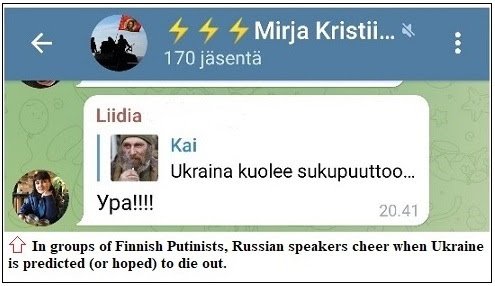
Social media platforms reveal in their own harsh way how “ordinary Russians” relate to the atrocities of their compatriots in Ukraine. In this case, it must be considered that commentators from different groups form a one-dimensional sample of the entire nation. Millions of Russians do not have the opportunity to access the Internet regularly, on the other hand, this group is mainly dependent on the programs of Russian state television channels, so it is more than likely that they sympathize with the war as well as with the brutal murder of Ukrainians. So, I believe that the photo collage below with explanations describes the attitude of Russians towards their countrymen in Ukraine crimes committed quite well.


You can find quite a lot of messages from Russians like the examples in the photo collage on Telegram, YouTube, and many other social media channels. The messages convey an image of a country and people that are morally degenerate and corrupt!

The arrogance and contemptuous behaviour of the Russians and those who support them no longer even amazes me. A little over a year ago, I imagined that this kind of behaviour would slowly fade away, but still this group of Russians behaving like jerks is the one who controls the space while other Russians stay out (or are content to be silent). The Russians also seem to get energy for their actions from their ability to “play victims” and see the reason for the bad treatment of Russia and Russians only in other countries and peoples. The fact that the state is totalitarian and the punishments for opponents of the regime are long is also not a defense for the Russians. Nor is it that, being apolitical individuals, they protect their loved ones (or even want to maintain their relationship with them).

These do not serve as a defense, because we have seen Russians go to resistance individually or in groups, the bravest have taken up arms and gone to war against their countrymen. There are also critics of the Russian regime in Finland, some of the Russians living in Finland are very active on social media, fighting against the lies of the Kremlin, so the explanation “I am an apolitical person” is nothing more than an excuse to remain silent.

If Russia intends to one day return to the ranks of civilized nations, the Russians collectively have a considerable period of introspection and review of their own actions - and not only their own, but the entire country’s past actions ahead of them is a critical review and reconciliation! Without this, Russia should be kept isolated until there is a will to critically examine the past and to atone for its actions.


Marko


Sources: 

1. https://www.is.fi/jaakiekko/art-2000009293343.html 

2. https://www.hs.fi/kotimaa/art-2000009239132.html 

3. https://yle.fi/a/3-12450742 

4. https://yle.fi/a/3-12436052 

5. https://www.hs.fi/kotimaa/art-2000008779634.html 

6. https://putinintrollit.fi/2022/05/05/suomenvenalaisten-whatsapp-ryhmassa-keskustellaan-aseiden-tuomisesta-venaja-mieliseen-kulkueeseen-ja-lietsotaan-vihaa-ukrainalaisia-vastaan/ 

7. https://www.rferl.org/a/germany-pro-russia-rallies-discrimination/31795983.html 


Original blog in Finnish: ”Tavallisen venäläisen” toive: Median pitäisi lännessä kertoa Ukrainan sodasta myös Venäjän näkökulma.

RuFi ry – part of Russian propaganda and influence in Finland. 


#StandWithUkraine 


maanantai 3. huhtikuuta 2023

Vuosi Butšasta: me emme unohda, me emme anna anteeksi


Vuosi sitten, 31. maaliskuuta, Kiovan luoteispuolella sijainnut Butša vapautettiin venäläismiehityksestä. (1) Vapautusta seuranneina päivinä maailmalle alkoi virrata kuvia tuhosta, hävityksestä ynnä barbaarimaisesta murhaamisesta – ihmisten oli vaikea ymmärtää näkemäänsä, epäiltiin kyseessä olleen yksittäisten teloitusluonteisten murhien järjestäytyneen toiminnan sijaan. Mitä enemmän tietoja kuvien ohella miehityksestä vapautetuilta alueilta alkoi tihkua, aloimme ymmärtää toiminnan suunnitelmallisuuden ja laajuuden. Kyse ei ollut yksittäisistä, toisistaan irrallisista teoista, vaan kymmenistä ja taas kymmenistä raakalaismaisista murhista. Teoista, joihin järjestäytyneen armeijan ei uskottu ryhtyvän – teoista tuli mieleen raakalaismaisen rikollisjoukkion silmitön hyökkäys suojaamattoman siviiliyhteisön kimppuun. Puna-armeijan perillisenä Venäjän asevoimat ja asevoimien kintereillä liikkuneet turvallisuusjoukot sekä erilaiset palkka-armeijan yksiköt toteuttivat perinteisiä metodeja, niitä samoja, joihin isoisovanhempansa olivat syyllistyneet toisen maailmansodan aikana ja joihin Venäjän asevoimat oli syyllistynyt Syyriassa käynnissä olevassa sodassa kuin myös Tšetšenian sodissa ja joihin turvautumisesta oli kertynyt viitteitä jo Itä-Ukrainasta kuin myös miehitetyltä Krimin niemimaalta. Muistutan mitä Keir Giles kirjoittaa uusimmassa teoksessaan –

”Venäjän tapa käydä sotaa on pysynyt johdonmukaisena, koska se tuottaa johdonmukaisesti onnistumisia. Menetelmään kuuluvat asutettujen alueiden ottaminen maaliksi, mahdollisimman suuren kärsimyksen aiheuttaminen siviileille ja uhrien pakottaminen alistumaan kärsimysten lopettamiseksi. Murhat, raiskaukset, ryöstelyt ja humanitaaristen katastrofien tahallinen tehtailu mahdollisimman suuren inhimillisen kärsimyksen tuottamiseksi ovat jatkuneet samanlaisina läpi historian” ja ”Ukrainan kansalaisten karkotukset Venäjälle ovat uusi kammottava todistus siitä, että Venäjä pitää Stalinin menetelmiä vastauksena ongelmiinsa”. (2)

Osasin odottaa jotain näkemämme kaltaista sen perusteella, mitä olin nähnyt tapahtuvan aiemmin miehitetyssä Itä-Ukrainassa ja miehitetyn Krimin niemimaan alueella. Varautumisesta huolimatta Venäjän on onnistunut pahuudessa ja julmuudessa yllättää minut. En nimittäin uskonut, että SE kuitenkaan ryhtyy Ukrainassa tuhoamaan kokonaisia kaupunkeja tykistön ”teräsmyrskyillä” ja murhaamaan siviilejä kymmenin tuhansin maailman katsellessa voimattomana vierestä.


Mitä Butšassa tapahtui

Muistellessamme mitä Butšassa tapahtui, on meidän palattava ajassa takaisin vähintäänkin helmikuun 24. päivään (v. 2022) hetkeen, jolloin Venäjä laajensi sotaa Ukrainassa. Venäjän laajan offensiivin eräänä tavoitteena oli Ukrainan pääkaupungin Kiova valtaus muutamassa päivässä. Todennäköisimpien tavoitteiden joukossa oli myös Ukrainan presidentin Volodymyr Zelenskyin ja merkittävimpien poliitikkojen vangitseminen (mahdollisesti murhaaminenkin) ja eräänlaisen pseudovaltion muodostaminen valloitetun ja tuhotun Ukrainan tilalle. Nyt tiedämme, ettei Venäjä ole onnistunut asettamissaan tavoitteissa, se on myös paljastunut merkittävästi kyvyttömämmäksi sotilaalliselta voimaltaan mitä oletimme sen olevan ennen 24. helmikuuta 2022.

Kiovan ohella Venäjä aloitti laajat maaoperaatiot (tavoitteisiin nähden aivan liian vähäisin voimin) usealla rintamalla kautta Ukrainan. Miehitetyn Krimin niemimaan alueelta Venäjän joukot etenivät Hersonin alueelle ja sieltä kohti Zaporižžjan aluetta: miehitetyn Itä-Ukrainan aluetta Venäjä käytti ponnahduslautana edetessään kohti Mariupolia sekä vapaata Luhanskin aluetta: Belgorodin alueelta Venäjältä sen hyökkäyskärjet etenivät kohti Harkovaa – ne pysäytettiin kaupungin porteille, ja Sumyn alueeseen rajoittuvilta alueilta Venäjältä, sen hyökkäyskiilat lähtivät kiirehtimään niin ikää kohti Kiovaa – hyytyen täälläkin kapeina kärkinä Kiovan itä- ja koillispuolelle joukkojen huollon romahtaessa.

Kiovaa Venäjä tavoitteli useammalla hyökkäyskärjellä, koillisesta Sumyn alueen kautta kohti Kiovaa eteni kaksi hyökkäyskiilaa; Valko-Venäjältä käsin venäläiset etenivät etelään ja kohti Kiovaa Dneprin molemmin puolin, Tšernihivin alueen sekä Tšernobylin suojavyöhykkeen kautta. Tšernihiv muodostui tulpaksi, jota venäläisten ei onnistunut kunnolla saarrostaa eikä ohittaa, Tšernobylin suojavyöhykkeen kautta edenneet joukot tavoittivat Kiovan suurkaupunkialueen liian myöhään kyetäkseen tukemaan Hostomelin lentokentälle maihinlaskun tehneitä maahanlaskujoukkoja, joista osan Ukrainan asevoimat yhdessä aluepuolustusjoukkojen kanssa pyyhkivät taisteluissa olemattomiin.

Venäjän ei onnistunut saarrostaa ja valloittaa Kiovaa suunnitelman mukaisessa ajassa, muuttui sen sodankäyntitapa kautta Ukrainan entistä totaalisempaan suuntaan – olemme nähneet venäläisten toteuttavan samaa aiemmin Syyrian Aleppossa sekä Groznyissa Tšetšeniassa. Epäonnistumisen jälkeen rikollisen sodankäyntitavan kohteeksi joutuu eurooppalaisia miljoonakaupunkeja, kuten Kiova ja Harkova sekä lähes Helsingin kokoinen Mariupol, jonka rakennuskannasta venäläinen ”teräsmyrsky” vaurioitti ja tuhosi merkittävän osan. Venäjälle tällainen kaupunkeja tykistöllä ja ilmaiskuilla murskaava sodankäyntitapa on taktiikka, jonka avulla on tarkoitus murskata kohteen vastarinta. Tehdä heidän elämästä helvettiä, mikä vähentäisi kansan (ja poliitikkojen) halua pitkittää sotaa – Ukrainan kohdalla tulos on täysin päinvastainen. Kuten olemme nähneet, ukrainalaiset eivät antaudu – brutaali sodankäyntitapa ei nujerra heitä, ennemminkin se lisää heidän halua taistella vastaan. Ukrainalaiset ymmärtävät mitä antautumisesta seuraa, sama kuin Butšassa, mutta monta kertaluokkaa suurempana. Butšassa näimme pienoiskoossa sen, mitä Venäjän miehittämässä Ukrainassa tapahtuisi – kansanmurha.

Venäläisten murhaamia siviilejä Butšassa, osalla murhatuista kädet oli sidottu kiinni selän taa.


Vuosi sitten, 31. maaliskuuta 2022, Kiovan luoteispuolella sijainnut Butša vapautettiin kuukauden kestäneestä venäläismiehityksestä. (3) Seuranneina päivinä maailmalle alkoi virrata kuvia tuhosta, hävityksestä ja brutaaleista siviileiden murhista. Ukrainalaisten viranomaislähteiden mukaan Butšan alueelta löydettiin miehityksen jälkeen 458 siviilin ruumiit, joukossa oli 9 lasta ja alle 18-vuotiasta nuorta. Kuolleista 419 oli tapettu ampumalla ja loput luonnollisista syistä, joista osa on todennäköisesti seurausta miehityksestä. (4) Aivan kuten Butšassa myös vapautetusta Irpinistä löytyi kymmenittäin murhattuja siviilejä. Muistamme myös perheen, joka menehtyi Irpinissä venäläisten tulittaessa kranaatinheittimillä evakuointikäytävällä edenneitä siviilejä 6. maaliskuuta 2022. 

Kiova – Žytomyr välinen E-40 moottoritie – kymmeniä siviiliuhreja lyhyellä matkalla.


Maailmaa järkyttivät myös julmat näyt Kiovasta länteen vievän E-40 moottoritien varrelta, alueella vierailleet toimittajat laskivat moottoritieltä lyhyeltä matkalta toistakymmentä ampumalla murhattua siviiliä. (5)

Miehityksen aikana Kiovan alueella menehtyi yhteensä 1374 siviiliä, joista 38 oli lapsia – huomattavalla osalla kuoleman aiheutti pienikaliiperiset aseet. Venäläisten miehityksen jäljiltä on Kiovan alueella edelleen siviilejä kateissa, osan venäläiset veivät vetäytyessään Valko-Venäjän kautta Venäjälle.

Huhtikuun 2. päivään mennessä koko Kiovan alue oli vapautettu, viranomaisten ilmoituksen mukaan Kiovan alueella ei ollut enää ainoatakaan miehittäjän sotilasta. Kiovan alueen ohella Venäjä vetäytyi vuosi sitten Tšernihivin alueelta ja lopulta myös Sumyn alueelta. Venäjän hyökkäyssodan tuoma painajainen ei kuitenkaan vielä päättynyt. Kiovan alueen taisteluiden päätyttyä, Venäjä on iskenyt Kiovaa ja Kiovan alueen siviilikohteita vastaan useita kertoja risteilyohjuksin sekä itsemurhalennokein, pääasiassa iranilaisvalmisteisin HESA:n Shahed 136 -itsemurhalennokein (osassa lennokeista on Geran-2 merkintä, jota nimeä Venäjällä järjestelmästä käytetään). Venäjä on myös iskenyt toistuvasti tykistöaseilla siihen rajoittuviin Ukrainan pohjois- ja koillisosiin Tšernihivin ja Sumyn alueilla.

Maailmaa on myös tyrmistyttänyt se, ettei Venäjä ole ryhtynyt minkäänlaisiin rangaistustoimenpiteisiin tunnistettuja sotarikoksiin syyllistyneitä sotilaita kohtaan, ennemminkin päinvastoin. Venäjä on nimittäin palkinnut joukko-osaston, jonka sotilaiden on tunnistettu syyllistyneen sotarikoksiin Kiovan alueella – huhtikuun 18. päivä Vladimir Putin nimesi 64. erillisen motorisoidun kivääriprikaatin kaartin -arvolla, prikaatin ajettua Putinin mukaan ”isänmaan ja valtion etua”, ylistäen prikaatin ”joukkosankaruutta ja urheutta sekä sitkeyttä ja rohkeutta”. (6) Useita kyseisen prikaatin sotilaita on tunnistettu, prikaatin komentajana toimi Butšan verilöylyn aikaan everstiluutnantti Azatbek A. Omurbekov. Ukrainan sotilastiedustelun keräämien ja julkistamien tietojen perusteella kyseinen prikaati on ollut sijoitettuna Butšan alueelle kaupungin miehityksen ajan Venäjän toteuttamaan joukkojen vetäytymiseen saakka. Tiedot on myös vahvistettu muiden lähteiden toimesta. 

64. erillisen motorisoidun prikaatin komentaja everstiluutnantti Azatbek A. Omurbekov.


64. erillisen motorisoidun prikaatin ohella Butšassa sotarikoksiin on varmuudella syyllistynyt joukkoja Pihkovaan sijoitetusta 76. kaartin ilmarynnäkködivisioonasta (Venäjän maahanlaskujoukot eli VDV) sekä Tšetšenian sisäministeriön joukkoja eli Kadyrovtsyja. Huomioitavaa on kuitenkin se, että Venäjän asevoimat etenivät Butšan kautta Irpiniin koettaessaan valloittaa Kiovan, joten siviileiden satunnaiseen murhaamiseen ja muihin veritöihin on voinut osallistua joukkoja useammistakin yksiköistä. Associated Press’in  eli AP:n mukaan Butšan alueen miehityshallintoa johdettiin 76. kaartin ilmarynnäkködivisioonan esikunnasta Jablunska kadulta, esikuntaan sijoitetut joukot koordinoivat myös siviiliväestöön kohdistuvia puhdistuksia, reserviin siirtyneiden ukrainalaissotilaiden etsintöjä kuin myös muita julmuuksia. Butšasta löytyi myös kuulustelu- ja kidutuskellareita sekä teloituskammio. Huomioitavaa on myös, että siviileitä teloitettiin kaduille venäläisten toimesta, ruumiit jätettiin niille sijoilleen eikä paikallisten annettu haudata niitä päiviin. Siviileitä teloitettiin myös metsiköihin kaivettuihin tilapäishautoihin jne. 


Suurin osa siviiliuhreista tuli miehityspäivien ja viikkojen kuluessa, vasta kaupungista käytyjen taisteluiden jälkeen. Taistelut kaupungista päättyivät 12. maaliskuuta 2022, jolloin koko kaupunki oli venäläisten hallussa, ja jonka jälkeen alkoivat siviiliväestön systemaattinen vainoaminen, kollaboraattoreiden ilmiantamien asukkaiden etsinnät ja kiduttaminen, mikä päättyi useiden kohdalla teloitukseen. Kaupungin pormestarin Anatoli Fedorukin 28. maaliskuuta antaman haastattelun mukaan venäläiset ovat syyllistyneet Butšassa ”rikoksiin ihmisyyttä vastaan”. (7) Butšassa ja Kiovan alueella on raportoitu tapahtuneen Venäjän miehityksen aikana 9000 sotarikosta.

Ukrainalaisten tuskaa on lisännyt Venäjän toistuva rikollisten tekojensa kiistäminen, väittäminen Butšan sotarikoksia lännen propagandaksi ja valheeksi, jota narratiivia omalla toiminnallaan Venäjälle työskentelevät propagandistit avustajineen ovat voimistaneet. Totuutta tämä ei luonnollisesti muuta miksikään, mutta Venäjän valtio on tuonut tämän julman valheen osaksi kansainvälistä diplomatiaa ja organisaatioiden työskentelyä, mikä on erityisen halveksuttavaa ja vastenmielistä. Häpyä ei myöskään ole Venäjän operaattoreiden ja propagandistien toiminnassa, samaa räikeiden valheiden toistamista nähtiin reilua viikkoa myöhemmin Venäjän tulittaessa Kramatorskin rautatieasemaa ballistisilla OTR-21 Totška-U-ohjuksilla 8. huhtikuuta 2022. (8)

Vuosi Butšan sotarikosten jälkeen Venäjä jatkaa valheiden levittämistä.


“When Bucha was de-occupied, we learned that the devil was not somewhere “out there” but was in fact here on Earth.” Ukrainan presidentti Volodymyr Zelenskyi. (9)


Marko


Lähteet:

1. https://www.understandingwar.org/backgrounder/russian-offensive-campaign-assessment-april-1

2. Keir Giles: Venäjän sota jokaista vastaan ja mitä se sinulle merkitsee, s. 178.

3. https://www.understandingwar.org/backgrounder/russian-offensive-campaign-assessment-april-1

4. https://babel.ua/en/news/82626-at-least-458-ukrainians-died-in-the-bucha-community-as-a-result-of-the-actions-of-the-russians 

5. https://www.youtube.com/watch?v=HNTPyAsMmxs 

6. https://www.rferl.org/a/russia-bucha-brigade-honorary-title-war-crimes/31809612.html 

7. https://web.archive.org/web/20220406114727/https://japantoday.com/category/world/russian-media-campaign-dismisses-bucha-deaths-as-fakes 

8. Esimerkiksi Janus Putkosen 8. huhtikuuta 2022 kirjoittama twiitti ja Sofia Kazakovin Facebook-päivitys 3. huhtikuuta 2022: Butšasta Kramatorskiin – Kremlin valhe leviää myös suomaisissa verkostoissa.

9. https://twitter.com/DefenceU/status/1641891268157493260 


Lähteinä hyödynnetty myös Informnapalmin toimittamaa aineistoa, GUR:n kokoamaa ja julkaisemaa tietoa ja Kyiv Independentin aineistoa.


#StandWithUkraine